What Is Bare Metal Server and Why Do You Need One

Soraxus Assistant
January 14, 2026 • 20 min read
So, what exactly is a bare metal server?
In the simplest terms, it's a physical computer server that’s all yours. You get exclusive, direct access to every single one of its hardware resources—the CPU, the RAM, the storage, everything. There's no software layer, no virtualization, and no sharing with other users.
Think of it this way: a bare metal server is like owning a house, while most cloud or virtual server options are like renting an apartment. With the house, every square foot is yours to use as you see fit. In an apartment, you're sharing the building's foundation, plumbing, and electrical systems with other tenants.
That apartment building is the virtualized world. A powerful physical server gets sliced up into smaller, isolated "apartments" called virtual machines (VMs) using a software layer known as a hypervisor. It's an efficient way to house many users on one machine, but it comes with a trade-off: performance overhead. All your requests have to go through that management layer first.
A bare metal server cuts out the middleman. Your operating system sits directly on the hardware, giving your applications a direct line to the machine's full power. Every processor cycle and every byte of memory is dedicated to your work, and yours alone.
This direct-to-hardware access is what creates the fundamental differences between bare metal and virtualized hosting. These distinctions aren't just technical details; they have a real impact on everything from application speed to security.
For an even deeper dive into this, check out our guide on the differences between a dedicated server vs VPS.
The Hallmarks of a Bare Metal Server
Here’s a breakdown of what truly makes bare metal stand out:
-
Exclusive Resource Access: You are the one and only tenant. This eliminates the "noisy neighbor" problem, where another user's resource-heavy application could slow yours down. Your performance is stable and predictable. For example, your e-commerce site won't suddenly slow down because another customer on the same physical machine launched a resource-intensive data analysis job.
-
No Hypervisor Layer: Without that virtualization software getting in the way, your applications talk directly to the server's components. This means lower latency and higher throughput—an absolute must for demanding workloads like databases, real-time gaming, and financial trading platforms.
-
Total Control: You get full root access. This lets you install any operating system you want (even a custom one) and tweak the hardware and software configuration to match your exact needs. It's your machine, your rules.
-
Rock-Solid Security: Physical isolation is a huge security advantage. Since you aren't sharing the underlying hardware, you're walled off from vulnerabilities that might affect other tenants in a multi-tenant environment. This is a game-changer for businesses handling sensitive data, such as a healthcare provider needing to meet strict patient data privacy standards.
Bare Metal Server vs Virtual Machine at a Glance
To make it even clearer, let's put bare metal and virtual machines side-by-side. The table below offers a quick comparison of where they differ most.
| Characteristic | Bare Metal Server | Virtual Machine (VM) |
|---|---|---|
| Tenancy | Single-tenant (dedicated to one user) | Multi-tenant (multiple VMs share one physical server) |
| Resource Access | Direct and uncontended access to all physical hardware. | Shared and virtualized resources, allocated by a hypervisor. |
| Performance | Maximum performance with zero virtualization overhead. | Good performance, but subject to hypervisor overhead and "noisy neighbors." |
| Isolation | Complete physical isolation, providing a high degree of security. | Logical isolation between VMs, but they share the same physical attack surface. |
| Control | Full root access to install custom OS and fine-tune hardware settings. | Limited to the OS and configuration options provided by the hosting provider. |
| Ideal Use Cases | High-performance computing, large databases, gaming, security-sensitive applications. | Web hosting, development/test environments, general-purpose business applications. |
While VMs are incredibly flexible and cost-effective for a wide range of tasks, bare metal servers remain the go-to choice when raw performance, unwavering consistency, and maximum security are non-negotiable.
How Bare Metal Servers Actually Work
So, we know what a bare metal server is, but how does it all come together? Think of it less like a single product and more like a carefully orchestrated symphony of high-performance hardware, all playing just for you.
This setup is built on a simple but powerful foundation. It starts with latest-generation CPUs from heavy-hitters like Intel and AMD, giving you the raw computational muscle you need. Backing that up is a ton of high-speed RAM and, critically, ultra-fast NVMe storage. We’re talking about data access speeds that leave traditional hard drives in the dust.
The key difference? In a virtual environment, a hypervisor slices up and manages these resources. Here, your operating system gets a direct, unfiltered connection to the hardware. No middleman, no overhead.
From Days to Minutes: The Modern Provisioning Process
Not too long ago, getting a physical server up and running was a real headache. It was a manual job that could drag on for days, sometimes even weeks. Thankfully, modern automation has completely flipped the script. Today, providers can spin up a fully configured bare metal server—OS, networking, and all—in just a few minutes.
This isn't magic; it's just incredibly sophisticated automation. When you place an order, a behind-the-scenes platform jumps into action:
-
It finds a physical machine that matches your hardware specs.
-
It installs your chosen operating system (like Ubuntu, CentOS, or Windows Server) from a master image.
-
It handles all the network configurations and assigns your IP addresses.
-
Finally, it hands you the secure credentials so you can log in immediately.
This kind of rapid deployment gives you the best of both worlds: the raw power of dedicated hardware combined with the on-demand agility you'd expect from the cloud.
The diagram below really nails the architectural difference between bare metal and virtual servers.
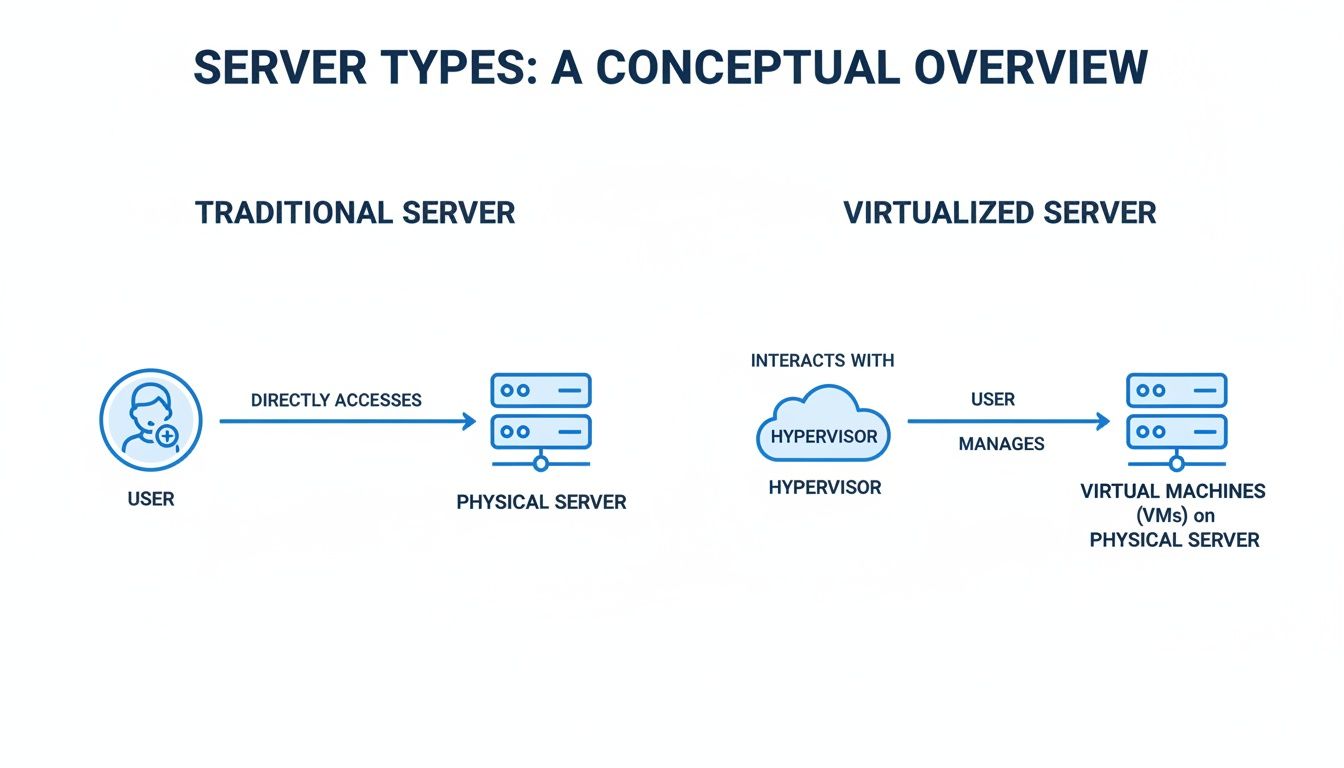
As you can see, the bare metal setup is a direct line from you to the server. The virtualized model, on the other hand, puts that hypervisor layer right in the middle, managing access for multiple tenants.
Complete Control with Root and OOB Access
One of the biggest draws of a bare metal server is the absolute, uncompromising control you get. You're given full root access (or Administrator on Windows), which is the highest level of command on the machine. You can install any software you want, tweak the OS kernel, and fine-tune every last setting to squeeze every drop of performance out of the hardware.
But what if a bad config change locks you out? Or worse, the whole operating system crashes? That’s where Out-of-Band (OOB) management becomes your safety net.
Think of OOB management as a separate, dedicated remote control for your server's core hardware. It operates on an independent network, allowing you to access the machine even if it's powered off or the primary network connection is down.
With OOB access, you can handle mission-critical tasks from anywhere, anytime. This includes things like:
-
Power cycling the server (a hard reboot, power on/off).
-
Accessing the system console just like you were physically plugged in with a keyboard and monitor.
-
Reinstalling the entire operating system from scratch if needed.
-
Monitoring hardware health and running diagnostics.
This deep level of control is non-negotiable for critical applications where downtime simply isn't an option. It’s what guarantees you can never truly be locked out of your own hardware. This demand for raw performance and control is why the bare metal server hosting service market is set to hit $15 billion in 2025 and is growing at a 15% CAGR through 2033, driven by the intense needs of AI, gaming, and big data workloads. You can read more about this expanding market and its key drivers in recent industry analysis.
Unlocking Peak Performance and Unbreakable Security
When you opt for a bare metal server, you're not just choosing hardware; you're investing in two critical advantages that virtualized environments simply can't match: raw, uncompromised performance and fortress-like security. These aren't just bullet points on a feature list—they are the bedrock for some of the most demanding applications on the internet.
The performance edge comes from eliminating what we call the "virtualization tax." Think of a hypervisor as a middleman sitting between your software and the server’s physical hardware. By getting rid of that layer, bare metal gives your application a direct, unfiltered connection to the CPU, RAM, and storage.
This direct access delivers real, tangible results. You get faster I/O, incredibly low latency, and consistent, predictable power. Since 100% of the server's resources are dedicated to your workloads, performance never dips because of a "noisy neighbor" on the same machine.
For mission-critical applications, predictable performance is non-negotiable. A bare metal server acts like a finely tuned engine, delivering the same level of horsepower day in and day out, without the random slowdowns common in shared environments.
Imagine a major e-commerce site during a flash sale. That sudden traffic surge can cripple a shared virtual server, leading to slow load times or even a full-blown crash. A bare metal server, on the other hand, can absorb that spike and keep processing transactions smoothly, protecting both the customer experience and your revenue.
How Direct Hardware Access Delivers Maximum Speed
Without a hypervisor in the way, the path for your data is clear and fast. This is absolutely essential for certain types of applications.
Here's how that plays out in the real world:
-
High-Frequency Trading: In financial markets, even a single millisecond of delay can cost millions. Bare metal delivers the near-instantaneous response times needed to execute trades at lightning speed.
-
Large-Scale Databases: For applications wrestling with massive datasets, direct access to high-speed NVMe storage is a game-changer. Queries run faster, data crunches more efficiently, and the whole application just feels snappier.
-
Real-Time Analytics: When you're processing streaming data for on-the-fly insights, any delay makes the information stale. Bare metal ensures your analytics engine has the full, undivided attention of the processor.
This is exactly why industries that live and die by speed and reliability—from scientific research to online gaming—build their infrastructure on bare metal.
A Fortress of Solitude: The Security of Single-Tenancy
Beyond pure speed, bare metal servers offer a powerful security advantage through physical isolation. Since you are the only tenant on the machine, your entire environment is physically separated from other customers. This single-tenancy model dramatically shrinks the attack surface.
In a shared, virtualized setup, a vulnerability in the hypervisor could potentially be exploited to peek into other virtual machines on the same host. Physical isolation eliminates this entire class of threats—a vital requirement for any organization with strict compliance standards.
-
HIPAA Compliance: Healthcare organizations handling sensitive patient data (PHI) need incredibly stringent protections. The physical isolation of bare metal is a key component in preventing data co-mingling and meeting these requirements.
-
PCI-DSS Compliance: Any business processing credit card payments must secure that cardholder data. A dedicated, isolated server is a foundational piece of building a compliant and secure payment environment.
This robust security posture gets even stronger with proactive defenses. Always-on DDoS mitigation, for example, acts like a digital bodyguard for your server. It inspects all incoming traffic, instantly identifying and blocking malicious floods before they can knock you offline. To see how this works, check out our guide on dedicated servers with DDoS protection. It’s how you ensure your infrastructure stays online and performing at its best, even when under attack.
Real-World Use Cases for Bare Metal Servers
It’s one thing to talk about raw power, but it’s another to see how it solves real problems. The true value of bare metal shines when you look at the specific applications that depend on it every single day. For certain jobs, dedicated hardware isn't just a preference—it's a fundamental requirement.
In these situations, the usual trade-offs of shared cloud environments, like unpredictable performance or potential security blind spots, are simply too risky. Whether it’s processing billions of financial transactions or delivering a perfect, lag-free gaming experience, bare metal provides the unshakable foundation needed for mission-critical work.
Let’s dig into a few key areas where bare metal isn't just an option, but an absolute necessity.
High-Traffic Databases and Big Data
Imagine a global financial trading platform that handles thousands of trades every second. At its heart is a massive database that needs to ingest data, run complex calculations, and spit out results in microseconds. Even the tiniest delay could mean a significant financial loss.
The Problem: In a typical virtualized setup, the I/O path to the storage drives gets filtered through the hypervisor. This adds a layer of latency, often called the "virtualization tax." For a high-frequency trading database, this kind of unpredictable lag is a deal-breaker.
The Bare Metal Solution: A bare metal server gives the database a direct, unobstructed line to its underlying NVMe storage. This allows for the absolute fastest read/write speeds and lowest possible latency, ensuring trades are executed instantly and reliably. The same idea applies to big data analytics, where churning through terabytes of information demands the full, sustained throughput that only dedicated hardware can deliver.
SaaS and E-commerce Platforms
Software-as-a-Service (SaaS) and e-commerce platforms live and die by their user experience. A slow-loading app or a checkout process that stumbles during a big sale is a quick way to lose customers for good. These platforms need to handle not just steady daily traffic but also massive, sudden spikes.
The Problem: A viral marketing campaign or a Black Friday sale can flood an e-commerce site with traffic. On a shared server, that surge could easily overwhelm the allocated resources, causing the whole site to slow to a crawl or even crash—a disaster for revenue and brand reputation.
The Bare Metal Solution: By running on dedicated hardware, these platforms get 100% of the server's CPU and RAM. This guarantees a consistently fast and snappy experience for every single user, even when traffic goes through the roof. The predictable performance of bare metal means a business can confidently handle those spikes without breaking a sweat.
The core value proposition of bare metal in this context is consistency. When your entire business runs online, you cannot afford the performance gambles associated with shared infrastructure. Dedicated resources mean predictable speed and reliability.
Online Gaming Communities
In the world of online gaming, latency is public enemy number one. A smooth, lag-free experience is non-negotiable for competitive play and keeping players happy. Gaming servers have to process player inputs at lightning speed, manage complex game states, and stream data back to thousands of players in real-time—all while fending off disruptive DDoS attacks.
The Problem: A shared virtual server introduces multiple points where latency can creep in. Worse, a DDoS attack targeting one game server on a shared host could cripple every other game running on that same physical machine.
The Bare Metal Solution: A bare metal server delivers the raw processing horsepower and low-latency network connection needed for a flawless gaming experience. More importantly, when you pair it with robust, always-on DDoS mitigation, you create a fortress. This combination ensures gameplay stays fast and fair, stopping malicious attacks before they can ruin the fun for everyone.
AI/ML and High-Performance Computing
Artificial intelligence and machine learning are some of the most demanding workloads out there. Training a complex AI model can mean chewing through enormous datasets for days or even weeks on end, and it requires every last drop of processing power you can get.
The Problem: Virtualization can eat up 20-30% of a server's resources just to run itself. For AI/ML jobs, that’s a massive performance penalty. This overhead means calculations take longer, models train slower, and the time it takes to get results gets stretched out, putting a brake on innovation.
The Bare Metal Solution: These intense workloads need direct, unfiltered access to powerful hardware like GPUs and CPUs. A bare metal server gets the hypervisor out of the way, allowing AI frameworks to talk directly to the metal. This maximizes computational efficiency, dramatically cuts down training times, and helps researchers and developers iterate on their models much, much faster. This efficiency is a key reason the rise of bare metal in AI and HPC is so significant, with the market projected to grow from $14.32 billion in 2025 to $36.71 billion by 2030.
Choosing the Right Bare Metal Provider
Picking a bare metal provider is a huge decision. It's not just about renting a box; you're choosing the foundation your entire application will be built on. Get it right, and you’ll have a stable, high-performance environment. Get it wrong, and you’ll be fighting performance bottlenecks and security headaches down the road.
This choice is getting more critical by the day. The demand for raw, single-tenant hardware is exploding, with the global bare metal market expected to hit an eye-watering $30 billion by 2025. You can read more about this explosive market growth and see why industries from finance to AI are driving this trend. The key takeaway? You need a partner who can handle today's needs and grow with you.
Evaluate the Core Hardware and Network
First things first: what's actually in the box? The quality of the physical gear makes all the difference, especially when you’re running something demanding.
Don't settle for outdated hardware. Look for a provider who stocks the latest-generation CPUs and gives you options. Just as important is the storage. For anything that needs fast I/O, like a busy database, high-speed Gen 4 or Gen 5 NVMe storage is non-negotiable. A good provider will also let you customize your setup, including specific RAID configurations, so you get the exact performance and redundancy you need.
The server is only half the story; the network is the other. A provider with a global network of data centers (Points of Presence, or POPs) lets you place your servers physically closer to your users, which is the easiest way to slash latency. Always dig into their public uptime guarantee (the SLA) and ask about their network. Who do they peer with? How is their traffic routed? These details directly impact how fast and reliable your connection will be.
Scrutinize Security and Support Services
Security can't be an add-on; it has to be built-in from the ground up. At a bare minimum, your provider needs to offer always-on DDoS mitigation as a standard part of their service.
When you're asking about DDoS protection, get specific. What's their total mitigation capacity in Tbit/s? Do they protect just the network layers (L3/L4) or application layers too (L7)? Is the mitigation instant and automatic? In the middle of an attack, sub-second response times are what keep you online.
Even with total control over your server, you're going to need a helping hand eventually. This is where the quality of support and management tools really shines.
-
Guaranteed Out-of-Band (OOB) Access: Think of this as your server's emergency backdoor. If the OS crashes or the network is unreachable, OOB access lets you get in to reboot, reinstall, or troubleshoot. It's a must-have.
-
Remote Hands Services: This service is an absolute lifesaver. Instead of you flying out to a data center, an on-site technician can handle physical tasks for you—swapping a drive, plugging in a cable, you name it.
-
24/7 Expert Support: Make sure their support is truly around the clock and staffed by people who know what they're doing. Look for a guaranteed response time. A 15-minute response SLA is a world away from "we'll get back to you within a few hours."
Assess Scalability and Flexibility
Finally, think about tomorrow. Your needs will change, so your provider should be able to change with you. A partner with a deep inventory of server specs, from entry-level machines to absolute monsters, gives you room to grow (or shrink) without the pain of migrating. For a better sense of how different hardware configurations affect cost, check out our guide on dedicated servers prices.
Flexibility also means keeping up with how modern infrastructure is built. Can you easily create a hybrid setup, mixing bare metal with other services? By looking closely at these core areas—the hardware, the network, the security, and the support—you'll find more than just a vendor. You'll find a partner genuinely invested in your success.
Frequently Asked Questions About Bare Metal Servers
Let's clear up some of the common questions that pop up when people start digging into bare metal. Getting these details straight can make a huge difference when you're deciding on the right infrastructure.
Is a Bare Metal Server the Same as a Dedicated Server?
Pretty much, yes. In most conversations, "bare metal server" and "dedicated server" mean the same thing: a physical server that's all yours, with no other tenants and no hypervisor layer getting in the way.
But the language has shifted a bit over time. When someone says "bare metal" today, they're usually hinting at a more modern, cloud-like experience. Think automated provisioning that takes just a few minutes, management through an API, and flexible billing. The term "dedicated server," on the other hand, can sometimes still bring to mind the old-school, manual setup process.
How Long Does It Take to Deploy a Bare Metal Server?
Not long ago, getting a physical server up and running was a real waiting game. You could be looking at days, sometimes even weeks, for a technician to rack it, cable it, and install the OS. Thankfully, those days are over.
With modern automation, a fully configured bare metal server can be online and ready for you in just a few minutes. The whole process—installing your OS, setting up the network, and handing you the keys—is completely automated. You can get to work almost immediately.
This leap from manual drudgery to on-demand provisioning is one of the biggest game-changers in hosting. It means you get all the raw power of dedicated hardware without giving up the speed you expect from the cloud.
Can I Integrate Bare Metal with My Cloud Services?
Absolutely. In fact, this is one of the smartest ways to build a high-performance infrastructure. It's called a hybrid cloud strategy, and it lets you cherry-pick the best tool for each job.
For example, a large retail business could run its core, I/O-hungry inventory database on a powerful bare metal server for rock-solid speed and reliability. At the same time, it could use scalable virtual servers to handle its public-facing website, spinning up new instances to handle a traffic spike during a holiday sale and then spinning them down afterward to save money. You get stable, predictable power where it counts and flexible scalability where you need it.
Ready to feel the difference that dedicated hardware makes? Soraxus provides enterprise-grade bare metal servers with the latest Intel and AMD CPUs, lightning-fast NVMe storage, and always-on DDoS mitigation to keep your mission-critical applications running at peak performance. Launch, scale, and secure your infrastructure today at https://soraxus.com.