Bare metal server hosting: unmatched performance and control you can trust

Soraxus Assistant
January 19, 2026 • 24 min read
If you're after pure, unadulterated performance, bare metal server hosting is the only way to go. It's simple, really: you get an entire physical server, all to yourself. This means 100% of the CPU, RAM, and storage is yours and yours alone, sidestepping the performance bottlenecks that plague shared environments.
What Is Bare Metal Server Hosting
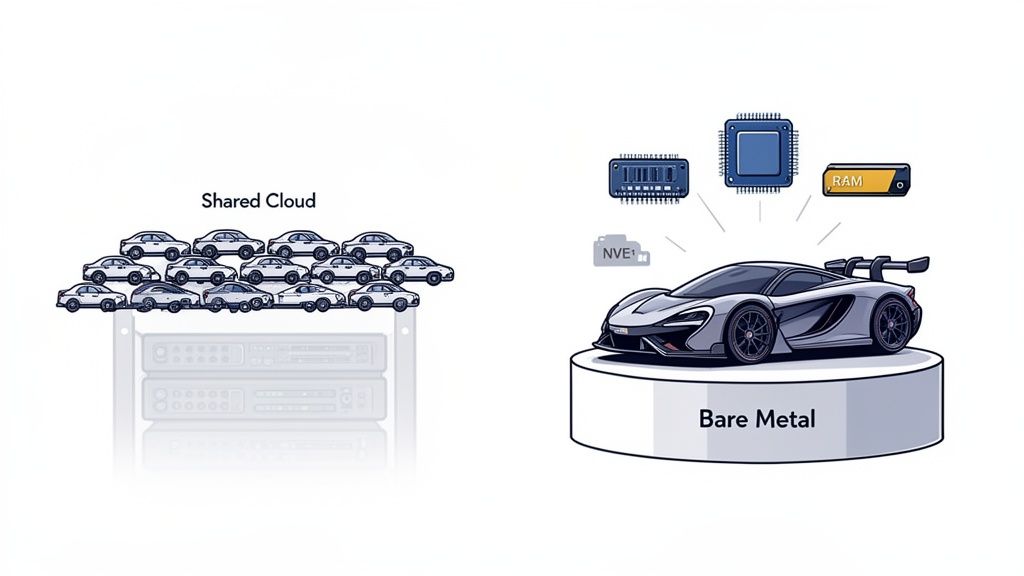
Think of it like this: you need to get to an important destination, fast. You could hail a shared ride, where you're at the mercy of other passengers and unexpected detours. Or, you could have a high-performance car with a professional driver waiting for you at the curb, ready to take the most direct route.
Bare metal server hosting is that private, high-performance car. It's a powerful, single-tenant physical server dedicated exclusively to your applications.
Unlike virtualized cloud servers, where a software layer called a hypervisor splits a single machine among multiple users, a bare metal server gives you raw, direct access to the hardware. There's no middleman. No overhead. Just pure power.
The Power Of Dedicated Resources
The single biggest advantage here is escaping the "noisy neighbor" problem. In a standard cloud or virtual private server (VPS) environment, your applications are sharing hardware resources. If another user on that same machine suddenly gets a massive traffic spike, their workload can hog the CPU or network bandwidth, slowing your application to a crawl. For example, a video encoding service on a shared server could suddenly slow down your e-commerce checkout process during a flash sale.
With a bare metal server, that entire problem vanishes. You're the only one on the machine. This physical isolation guarantees a few key things:
-
Maximum Performance: Your software gets every last drop of performance from the CPU cores, RAM, and storage I/O. There's no competition.
-
Rock-Solid Security: Being the sole tenant dramatically shrinks the attack surface. You don't have to worry about a vulnerability in a neighbor's virtual machine affecting you.
-
Total Control: You get full root access to install and configure the operating system, software, and security protocols exactly how you need them.
Bare Metal vs Virtualized Cloud Hosting At A Glance
To put it in perspective, let's break down the core differences between bare metal and the more common virtualized cloud model. The table below offers a quick snapshot of what you get—and what you give up—with each approach.
| Feature | Bare Metal Server Hosting | Virtualized Cloud Hosting |
|---|---|---|
| Performance | Highest possible; direct hardware access | Good, but with virtualization overhead |
| Resource Access | 100% dedicated, no sharing | Shared resources among multiple tenants |
| Noisy Neighbors | Not a concern; physically isolated | A significant risk to performance consistency |
| Control Level | Complete root access over OS and software stack | Limited; controlled by the provider's platform |
| Security | Highly secure due to single-tenancy and isolation | Shared environment introduces potential risks |
| Best For | High-performance computing, databases, game servers, AI | General-purpose websites, apps, development |
Ultimately, the choice comes down to your workload's specific needs. While virtualization offers flexibility, bare metal delivers the raw, predictable power that many modern applications demand.
When Performance Is Non-Negotiable
For some applications, the consistent, low-latency performance of bare metal isn't just a "nice-to-have"—it's an absolute necessity.
A bare metal server operates directly on the physical hardware without any intervening virtual layers. This distinction is crucial for workloads where every millisecond counts and resource contention is not an option.
Take a real-time analytics platform, for instance. To process user queries and return results instantly, it needs exclusive access to high-speed NVMe drives and dedicated CPU cores. That kind of responsiveness is nearly impossible to guarantee in a shared cloud setup, where virtualization can add unpredictable latency. Exploring the full range of dedicated infrastructure solutions shows how this raw power can be applied to solve specific business challenges.
It's no surprise that the demand for this kind of dedicated power is exploding. The global bare metal cloud market, valued at USD 12.4 billion in 2025, is on track to hit an incredible USD 102.4 billion by 2035. This massive growth underscores a clear trend: businesses running demanding SaaS platforms, game servers, and AI models are shifting away from virtualized options to get the performance they can truly count on. You can find more details about this expanding market and its drivers in recent industry reports.
The Building Blocks of a High-Performance Server
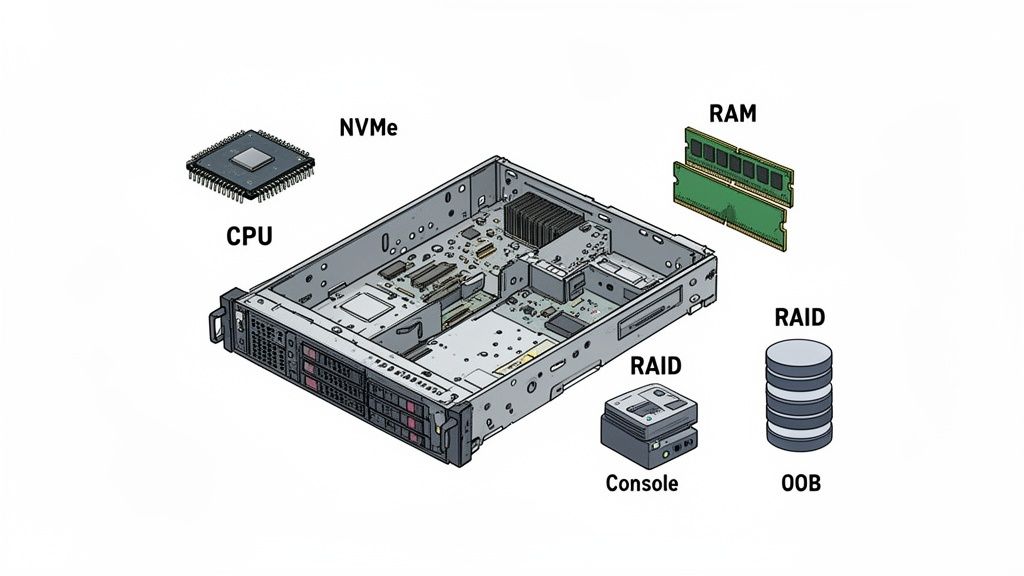
The incredible performance of a bare metal server isn't magic. It all comes down to the quality of its hardware and how well those components work together. To get the right machine for your workload, you really need to understand these building blocks, from the CPU right down to the storage drives.
When you have direct access to the physical hardware, every component choice you make has a real, immediate impact on how fast and reliable your applications are. Let's pop the hood and see what makes a high-performance bare metal server hosting environment tick.
The Brains of the Operation: CPU Power
The Central Processing Unit (CPU) is the engine of your server. It's what executes the code that makes your applications run. When you're speccing out a server, you absolutely want to focus on the latest-generation CPUs from major manufacturers. These newer processors pack in more cores and run at faster clock speeds, which gives you a direct, noticeable boost in performance.
Think about a development team trying to compile a massive codebase—a high-core-count CPU can slash that time significantly. Or a video streaming platform that needs to transcode multiple video streams at once without making users wait. More cores and higher speeds mean the server can juggle more tasks at the same time, far more efficiently.
Lightning-Fast Storage: NVMe and RAID
Storage speed is another critical piece of the performance puzzle. It directly controls how quickly your application can read and write data. While standard solid-state drives (SSDs) are a huge leap from old spinning disks, modern Gen 4 and Gen 5 NVMe (Non-Volatile Memory Express) drives are in a completely different league. They plug right into the motherboard's high-speed PCIe bus, sidestepping the slower data protocols that hold back older drives.
Imagine an e-commerce site during a Black Friday sale. The difference is night and day:
-
With standard SSDs: Product searches could lag, and the checkout process might feel sluggish as traffic spikes.
-
With NVMe drives: Searches are instantaneous, and checkouts stay snappy even with thousands of people hitting the site at once.
But speed isn't everything; you also need to protect your data. That's where RAID (Redundant Array of Independent Disks) comes into play. A RAID setup combines multiple physical drives into a single unit to boost performance, provide redundancy against drive failure, or both.
A RAID 10 configuration, for instance, merges the mirroring of RAID 1 (a perfect copy) with the striping of RAID 0 (data split across drives for speed). This gives you the speed of writing across multiple disks and the security of a complete, real-time backup if one drive dies.
This combination of speed and safety makes it a go-to choice for databases and other mission-critical applications where you simply can't afford downtime or slow performance. It’s the kind of peace of mind you need when your data is on the line.
Critical Connections: Networking and Management
A powerful server is useless without a great connection to the rest of the world and a way for you to manage it. High-performance networking with dedicated, unshared bandwidth is a must. It ensures data can fly in and out of your server without hitting traffic jams, which is absolutely vital for things like game servers or financial trading platforms where every millisecond counts.
Just as important, though less flashy, is Out-of-Band (OOB) Management. Think of this as your server's emergency back door. It’s a separate, secure connection that taps directly into the server’s management hardware, completely independent of the operating system or the main network.
If your OS crashes or a bad firewall rule locks you out, OOB management is your lifeline. It lets your DevOps team get in remotely to:
-
Reboot the server
-
Reinstall the operating system
-
Tweak BIOS settings
-
Diagnose hardware problems
This level of control is indispensable for disaster recovery and even just routine maintenance. It gives you ultimate authority over your hardware, no matter what’s going on with the software.
Unlocking Raw Performance and Fortified Security
When businesses opt for bare metal server hosting, it usually comes down to two things that virtual environments just can't quite deliver: pure, unfiltered performance and rock-solid security. These aren't just bullet points on a feature list; they're the direct result of the architecture itself. For applications where speed and safety are non-negotiable, bare metal is the foundation.
At its core, a bare metal server gets rid of the hypervisor—that software layer that carves up a physical server into smaller virtual machines. That one change gives your applications a direct, unimpeded line to the hardware. They talk straight to the metal, which means you get the absolute lowest latency and the highest possible Input/Output Operations Per Second (IOPS).
The Competitive Edge of Raw Speed
For some industries, that raw speed isn’t just a nice-to-have, it’s a critical competitive weapon. Take high-frequency trading, for example, where algorithms fire off millions of orders in the blink of an eye. The slightest delay—even just a few microseconds introduced by virtualization overhead—can be the difference between a profitable trade and a major loss.
A bare metal environment guarantees that every last drop of processing power from the CPU and every bit of throughput from the NVMe drives goes straight to the trading application. There's no fighting with other tenants for resources and no performance "tax" from a hypervisor. You get predictable, ultra-low-latency execution, every single time. It's this direct hardware access that gives these platforms their decisive edge.
A Private Fortress of Security
Beyond the sheer speed, the single-tenant nature of bare metal hosting naturally creates an incredibly strong security posture. Think of it like owning a standalone house versus renting an apartment. In an apartment building (a multi-tenant cloud), you share walls, plumbing, and maybe a front door. A security problem with one tenant could easily spill over and affect everyone else.
With bare metal, you own the whole property. This physical isolation shrinks your attack surface dramatically, wiping out the risk of "noisy neighbor" threats or cross-contamination from other users on the same machine. Your data and applications are walled off in their own private, fortified space.
This kind of isolation is essential for meeting compliance in industries like healthcare or finance, where regulations often mandate strict data segregation. For example, a healthcare provider can use a bare metal server to ensure patient data is never on the same physical hardware as another company's data, helping them meet HIPAA requirements.
Defending Against Modern Threats
Of course, physical isolation alone won't stop a determined attacker from the outside. That’s where you need to layer on advanced security measures. Enterprise-grade Distributed Denial-of-Service (DDoS) mitigation is absolutely essential for any serious bare metal setup; it’s the shield that protects your digital fortress.
Imagine a popular online gaming service that’s constantly being targeted by bad actors trying to knock it offline. To stay up and running, it needs a sophisticated, multi-layered defense. That includes:
-
Massive Mitigation Capacity: The network needs to be able to absorb and filter colossal waves of junk traffic. A global network with over 1.5 Tbit/s of capacity can handle even the biggest volumetric attacks without breaking a sweat.
-
Intelligent Traffic Filtering: Smart systems analyze incoming data in real-time, instantly telling the difference between legitimate gamers and malicious bots.
-
Application-Layer Protection: The defense has to go deeper than just network floods. It needs to protect against tricky attacks that target the game's application code itself.
By combining the inherent security of a single-tenant server with powerful, always-on protection, businesses can ensure their critical services stay online. To really understand how this works, you can dig into the details of modern DDoS protection services and their tiered approach.
The rapid growth of the bare metal market, which is expected to hit USD 78.79 billion by 2034, is a direct reflection of this dual need for speed and security. As more enterprises hunt for single-tenant environments for their demanding workloads, you can discover more insights about the bare metal market and its explosive trajectory.
Real-World Use Cases for Bare Metal Hosting
When does it make sense to go with bare metal? The short answer: whenever performance isn't just a "nice to have," but a non-negotiable part of your business. While virtual servers are great for flexibility, some jobs demand the raw, unshared power you can only get from dedicated physical hardware.
Let’s dig into the real-world scenarios where bare metal isn't just an option—it's the only one that makes sense. These are situations where milliseconds matter, and downtime can be catastrophic, from massive gaming communities to the backbone of global business software.
High-Performance Gaming Communities
In online gaming, latency is the arch-nemesis. A tiny bit of lag can be the difference between a win and a loss, and a consistently laggy experience is the fastest way to lose players. For competitive games with thousands of people connected at once, you need an environment that can process every action in the blink of an eye. That's bare metal's home turf.
Think about a huge multiplayer game with players logging in from all over the world. To make the experience fair and responsive for everyone, the infrastructure has to be rock-solid. Here’s how bare metal delivers:
-
Globally Optimized Network Routes: It’s all about finding the shortest, fastest path for data to travel, which keeps ping times low for everyone.
-
Robust DDoS Protection: Gaming servers are a magnet for DDoS attacks. A powerful mitigation system is essential to soak up those attacks and keep the game online.
-
Dedicated CPU Resources: The server’s processor is 100% focused on game logic, physics, and player interactions, with zero overhead from a virtualization layer.
Mission-Critical SaaS Platforms
If you’re running a B2B software platform—say, for logistics or inventory management—your customers are betting their own businesses on your service being available 24/7. Any downtime for you means lost money and lost trust for them.
This is where the sheer reliability of bare metal really shines. A SaaS company can architect an incredibly resilient service using servers with built-in redundancy and expert support. For instance, hitting a 99.99% uptime Service Level Agreement (SLA) becomes a realistic goal when your servers have:
-
A+B Redundant Power: With two separate power sources, the server stays up even if one fails.
-
24/7 Expert Support: When something goes wrong, you need real engineers on hand immediately—not a ticket queue—to fix hardware or network issues and minimize downtime.
-
Single-Tenant Security: Physical isolation means you never have to worry about a "noisy neighbor" hogging resources or creating a security risk. Your performance is consistent and predictable.
For these platforms, predictable performance isn't a luxury; it's a contractual obligation. Bare metal provides the stable, dedicated foundation needed to meet and exceed stringent uptime commitments.
Big Data and Analytics
Crunching massive datasets demands two things: huge amounts of processing power and ridiculously fast storage. Whether you're a bank analyzing market trends or a research lab processing scientific data, the speed of your hardware directly impacts how quickly you get answers. Virtual environments can really start to choke under the constant, high I/O workloads.
Bare metal servers, on the other hand, are built for this. When you combine powerful multi-core CPUs with the latest storage tech, you create the perfect environment for big data jobs. Specifically, that raw processing muscle paired with fast NVMe storage is what allows analytics platforms to chew through terabytes of data and spit out results in seconds, not minutes.
AI and ML Model Training
Training an AI or machine learning model is one of the most demanding computing tasks out there today. It involves feeding massive datasets into complex algorithms, a process that can run for days or even weeks. The biggest bottleneck is almost always the hardware’s ability to handle countless calculations at once.
This is why serious AI/ML development happens on bare metal. There are a few key reasons:
-
Direct Access to GPUs: Models train exponentially faster on dedicated Graphics Processing Units (GPUs). Bare metal gives your software direct, unfettered access to every ounce of a GPU's power.
-
High-Throughput Networking: When you're training a massive model across a cluster of servers, you need ultra-fast, low-latency networking to keep everything in sync without creating bottlenecks.
-
No Virtualization Overhead: By cutting out the hypervisor, you ensure that 100% of the hardware’s resources are thrown at accelerating the training process.
How to Choose the Right Bare Metal Provider
Picking the right bare metal provider is a whole lot more than just comparing prices. This decision directly impacts your application's performance, its security, and your ability to grow down the road. You have to look at the complete picture—from the quality of the hardware in the rack to the expertise of the support team you might have to call at 3 AM.
Think of it like choosing the foundation for a skyscraper. The wrong choice creates instability and future headaches, but the right one gives you a rock-solid base to build on. Let's walk through an actionable checklist to help you evaluate potential partners and make a confident choice.
This decision tree can help you visualize which aspects of bare metal are most critical for your specific goals.
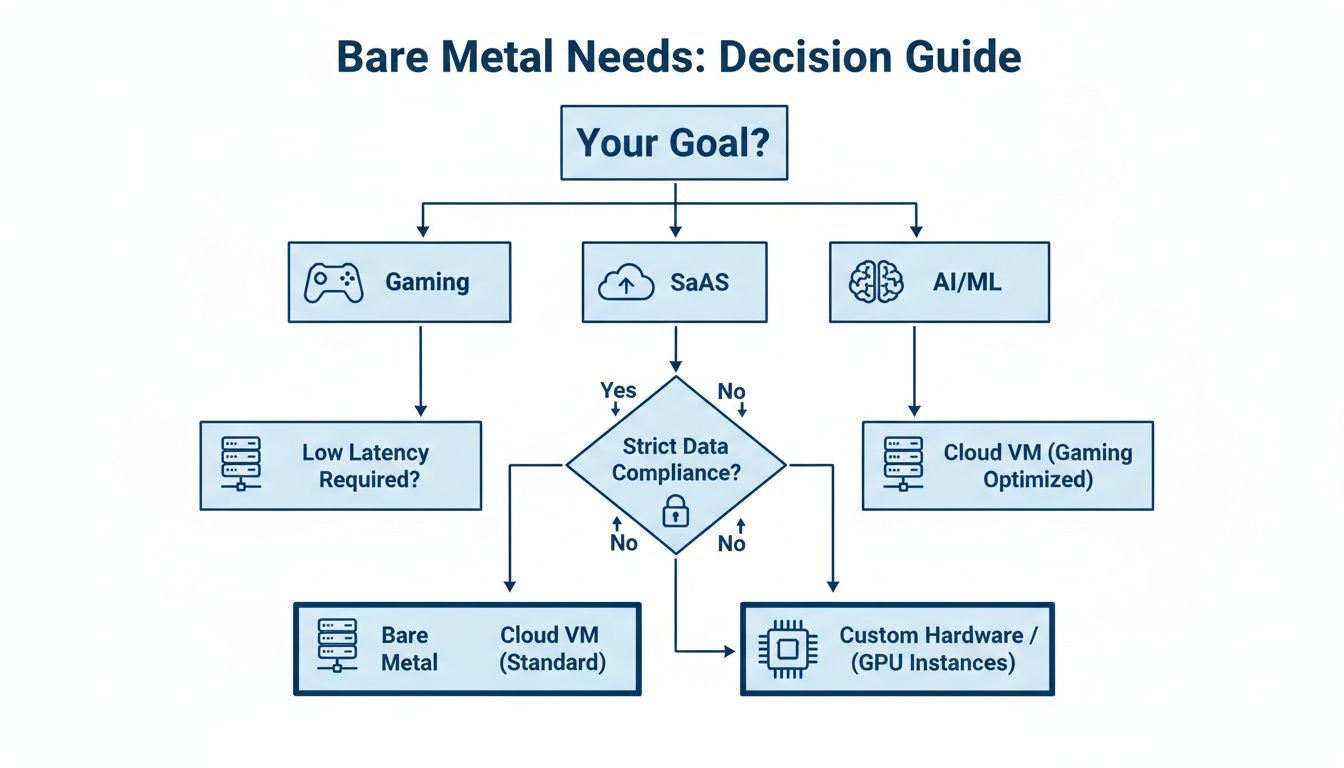
Whether you're spinning up a gaming community, a SaaS platform, or an AI/ML pipeline, the flowchart shows how different priorities lead to specific hardware and network needs.
Hardware Quality and Customization
The components inside your server are the engine powering your application. A provider offering outdated or limited hardware will cap your performance from day one. You need access to the kind of components that can handle your most demanding workloads without breaking a sweat.
When you're evaluating a provider, you need to dig into their hardware menu. Ask specific questions:
-
CPU Options: Do they offer the latest-generation processors from top manufacturers? Having access to higher core counts and faster clock speeds is essential for tasks like video transcoding or heavy database queries.
-
Storage Technology: Can you configure your server with high-speed Gen 4/5 NVMe drives? For something like an e-commerce platform, faster storage means dramatically reduced page load times and happier customers.
-
RAID Configurations: Do they support customizable RAID setups, like RAID 10? This is a must-have for balancing I/O speed with data redundancy for your mission-critical applications.
A provider that offers a wide range of modern, customizable hardware isn't just selling you a box; they're demonstrating a commitment to performance. It gives you the flexibility to build a server that perfectly matches what you're trying to achieve.
Network Performance and Reliability
A beast of a server means nothing if its connection to the world is slow or spotty. Network quality is a massive factor that directly affects user experience, especially for anything latency-sensitive like game servers or financial trading platforms.
Your provider's network is the central nervous system of your infrastructure. Look for a globally optimized network with a clear uptime SLA, as this is your guarantee of consistent connectivity and performance.
Examine the provider's network specs closely. You should be looking for a firm 99.99% uptime SLA that's actually backed by a resilient, multi-homed network architecture. It's also smart to ask about their total global network capacity and peering arrangements—these details determine how quickly and efficiently your data can reach users all over the world.
Security and DDoS Mitigation
In today's threat environment, robust security isn't just a nice-to-have, it's a requirement. Your bare metal server needs to be a fortress. The physical isolation of bare metal is a great start, but you also need serious protection from external threats.
The most critical security feature to scrutinize is DDoS mitigation. A powerful, always-on system is completely non-negotiable. Here's what to ask:
-
What is your total mitigation capacity? You want to hear a number like 1.5+ Tbit/s to ensure they can handle massive volumetric attacks.
-
How do you handle sophisticated application-layer (Layer 7) attacks?
-
Is the protection always active, or does it only kick in after an attack is already detected?
The market for bare metal is exploding, projected to be worth nearly USD 35 billion by 2025. A huge driver for this growth is the need for always-on protection for game hosts and web platforms.
Support Expertise and Response Time
When something goes wrong—and eventually, it will—the quality and speed of technical support can be the difference between a minor hiccup and a major, customer-facing outage. You need access to real engineers who can solve complex problems quickly, not just a first-line agent reading from a script.
Look for a provider that offers 24/7/365 support from an in-house team of actual experts. A key metric to ask for is their average support response time. An industry-leading benchmark is a 15-minute average response, which shows a real commitment to resolving your issues before they impact your business.
Data Center Standards and Colocation Features
Finally, don't forget the physical environment where your server actually lives. The quality of the data center underpins the reliability of everything else. High-quality facilities should offer features like A+B power redundancy, which ensures your server stays online even if one entire power circuit fails.
You should also inquire about their physical security protocols and what on-site services are available. For businesses that might eventually scale into their own hardware, understanding the provider's colocation services is also a smart move. It can reveal a lot about a provider's long-term commitment to running enterprise-grade infrastructure.
A Practical Checklist for Choosing Your Provider
To make this process easier, we've put together a checklist. Use these questions to systematically compare providers and ensure you're not missing any critical details.
| Vendor Evaluation Checklist for Bare Metal Hosting |
| :--- | :--- | :--- |
| Evaluation Category | Key Questions to Ask | Industry Best Practice (e.g., Soraxus Standard) |
| Hardware | Do you offer the latest-gen CPUs and Gen 4/5 NVMe drives? Can I customize RAID configurations? | Full access to the latest server components with flexible RAID 0, 1, 5, 10 options. |
| Network & SLA | What is your network uptime SLA? What is your global network capacity and what peering arrangements do you have? | A clear 99.99% uptime SLA backed by a multi-terabit global network with diverse peering. |
| DDoS Mitigation | What is your total mitigation capacity (in Tbit/s)? Is it always-on? Does it cover Layer 7 attacks? | 1.5+ Tbit/s always-on mitigation capacity with sophisticated Layer 7 filtering. |
| Technical Support | Is support available 24/7/365? Are they in-house engineers? What is your average response time? | 24/7/365 in-house engineering support with a 15-minute average response time. |
| Data Center | Do you offer A+B power redundancy? What physical security measures are in place? Are colocation options available? | Enterprise-grade facilities with A+B power, multi-layered security, and seamless colocation services. |
Choosing a bare metal host is a significant commitment. By armed with the right questions and a clear understanding of what to look for, you can find a partner that not only meets your technical needs today but can also support your growth for years to come.
Answering Your Questions About Bare Metal Hosting
Making the move to dedicated hardware can feel like a big leap. It’s natural to have questions. To help clear things up, we've compiled the questions we hear most often from businesses weighing their options. Here are some straightforward answers to help you see how bare metal server hosting works in the real world.
Is Bare Metal More Expensive Than Cloud Hosting?
It's a classic "it depends" situation, but not in the way you might think. While the monthly sticker price for a dedicated server might look higher than a small cloud VM, the true cost often flips for demanding workloads. With bare metal, 100% of the hardware resources you pay for are yours and yours alone. There’s no performance penalty from a shared virtualization layer.
What really trips people up with the cloud are the unpredictable costs, especially for data transfer. If you’re running a busy e-commerce site or a high-traffic application, those metered bandwidth fees can snowball. Often, a single, powerful bare metal machine can run circles around a whole cluster of pricey cloud instances, leading to major long-term savings and a bill you can actually predict each month.
How Difficult Is It to Migrate to a Bare Metal Server?
The migration process is less about the hardware and more about your specific application, but modern tools have made it much smoother than it used to be. You get full root access, which means your DevOps team is in a familiar environment and can use the standard tools they’re already comfortable with.
For instance, moving data is often as simple as using rsync, and you can deploy your applications using your preferred container platforms. The best providers also back you up with critical support. Having 24/7 expert support from real engineers and "remote hands" services—where a technician can physically assist at the data center—makes the whole transition feel less like a migration and more like a simple move.
What Is Out-of-Band Management and Why Is It So Important?
Out-of-Band (OOB) management is essentially your server's emergency backdoor. It's a secure, separate connection that talks directly to the server's hardware, completely bypassing the operating system and the main network.
Imagine having a virtual technician standing right next to your server, ready to step in at any moment. That’s what OOB management gives you. If your OS crashes, a bad firewall rule locks you out, or the server just stops responding on the network, this is your lifeline. Through OOB, you can:
-
Remotely reboot or power cycle the machine
-
Access the BIOS to tweak low-level settings
-
Reinstall the entire operating system from scratch
-
Diagnose hardware problems directly
It’s an indispensable tool for serious system administration and disaster recovery, giving you ultimate control right when you need it most.
Can I Get Cloud-Like Flexibility with Bare Metal Power?
Yes, and this hybrid approach is exactly where the industry is heading. You get the best of both worlds. Many top-tier bare metal providers now offer robust APIs that let you provision and manage dedicated servers with the kind of speed and automation you'd expect from the cloud.
No, deploying a physical server won't ever be as instant as spinning up a VM, but the timeline has shrunk dramatically. We're talking about getting a new, fully configured bare metal server online in hours—sometimes even minutes—instead of the old standard of days or weeks. This gives modern DevOps teams the raw, consistent performance they need from dedicated hardware, but with the agility they demand from their workflows.
Ready to harness the unmatched performance and control of dedicated infrastructure? The expert team at Soraxus is available 24/7 to design a bare metal server solution that meets your exact needs. Build your custom server today.