Compare vps vs dedicated server hosting: Which is best for you?

Soraxus Assistant
January 1, 2026 • 17 min read
The whole VPS vs. dedicated server hosting discussion boils down to one simple thing: a Virtual Private Server (VPS) gives you a private, virtualized slice of a shared physical server, whereas a dedicated server gives you the entire physical machine to yourself.
It’s like the difference between renting a high-end apartment and owning the entire building. What you choose really depends on what you need in terms of raw power, control, and, of course, your budget.
Decoding Your Hosting Needs
Picking the right hosting isn't just a technical task; it's a foundational business decision. With a VPS, a single, powerful server is cleverly partitioned into multiple isolated virtual environments. For many projects that can handle small performance dips, this is a smart, cost-effective solution and a massive upgrade from standard shared hosting. You get guaranteed resources and a lot more control.
The catch? You’re still sharing hardware, which means you can fall victim to the "noisy neighbor" effect. For example, if another user on the same physical server suddenly maxes out the CPU with a heavy database query, your e-commerce store might feel sluggish right at checkout. It's a real possibility.
A dedicated server sidesteps that problem completely. You get exclusive, bare-metal access to every CPU core, every gigabyte of RAM, and all the storage. This total isolation delivers the kind of predictable, rock-solid performance that's absolutely critical for applications where every millisecond of uptime and speed affects your revenue and customer trust.
Quick Comparison VPS vs Dedicated Server Hosting
To make things clearer, this table puts the two hosting models side-by-side, comparing the factors that matter most when making your decision.
| Attribute | VPS Hosting | Dedicated Server Hosting |
|---|---|---|
| Resource Allocation | Guaranteed virtual resources on a shared physical server. | 100% exclusive access to all physical server resources. |
| Performance | Generally strong, but can be impacted by other tenants. | Maximum, consistent, and predictable performance. |
| Security | Isolated at the software level, but hardware is shared. | Complete physical isolation offers the highest security. |
| Control & Customization | Full root access inside your virtual environment. | Full root/administrator access to the entire machine. |
| Ideal Use Case | Growing websites, dev environments, small business apps. | High-traffic e-commerce, SaaS platforms, gaming servers. |
| Cost | More affordable, with a lower barrier to entry. | Higher initial cost but a better price-to-performance ratio. |
Ultimately, the table shows a clear trade-off: a VPS offers a flexible and affordable middle ground, while a dedicated server provides uncompromising power and security for demanding workloads.
Understanding Performance and Resource Allocation
When you dig into the VPS vs. dedicated server hosting debate, it all boils down to one thing: how resources are handled. A Virtual Private Server (VPS) runs on a hypervisor, which is just a fancy term for software that slices up one powerful physical server into several smaller, isolated virtual ones. You get your own guaranteed slice of the pie.
But here's the catch: that virtualization adds a layer between your software and the actual hardware. While your slice of resources is reserved for you, it's still coming from a shared machine. This is where you can run into the dreaded "noisy neighbor" problem, making performance less predictable than you might like.
The Impact of Shared Hardware
Let's put this into a real-world context. Say you're running a busy e-commerce store on a VPS, and it's Black Friday. At the same time, another user on the same physical server kicks off a massive data processing job. Suddenly, the shared CPU and disk I/O are under immense strain. Your checkout pages start to lag, and you're watching potential sales disappear into abandoned carts.
That performance gamble is the fundamental trade-off of a VPS. You have your allocated resources, sure, but you never have the full, unbridled power of the underlying hardware at your disposal. Plus, the hypervisor itself needs a little bit of processing power to do its job, introducing a small but real performance overhead.
The Dedicated Server Advantage
A dedicated server throws all those variables out the window. You get direct, bare-metal access to the physical hardware. This means your application has exclusive, uncontested access to 100% of the CPU cores, RAM, and storage. There's no hypervisor, no resource competition, and definitely no "noisy neighbor" to slow you down.
For any application where consistent, low-latency performance is directly tied to revenue or user experience, this direct hardware access isn't just a nice-to-have—it's essential. Getting rid of the virtualization layer means zero overhead and all the processing power you paid for.
Think about a Software-as-a-Service (SaaS) platform running complex database queries. It needs consistently high I/O operations per second (IOPS) to keep users happy. On a dedicated server with blazing-fast NVMe storage, those operations fly without any virtualization bottlenecks getting in the way. The app stays snappy and reliable, even when it's getting hammered with traffic.
While a VPS offers the convenience of scaling virtual resources up or down, that flexibility comes at the cost of consistent performance. For any business running mission-critical applications, the raw, predictable power of a dedicated server is a direct investment in stability and happy customers.
Analyzing Security and Control Differences
When we start talking about VPS vs dedicated server hosting, the conversation around security and control is where things get really interesting. This is where the two models truly show their differences. A Virtual Private Server (VPS) does a great job of giving you a private, isolated space using a hypervisor, but you're still sharing the underlying physical server with other users. That shared foundation inherently creates a broader potential attack surface that just isn't a factor in a fully isolated setup.
While the virtualization technology itself is robust, it does represent a potential single point of failure. It's rare, but a vulnerability in the host server's hypervisor could, in theory, impact every single VPS running on that machine. For any business bound by strict regulatory standards, this shared-risk model can be a non-starter.
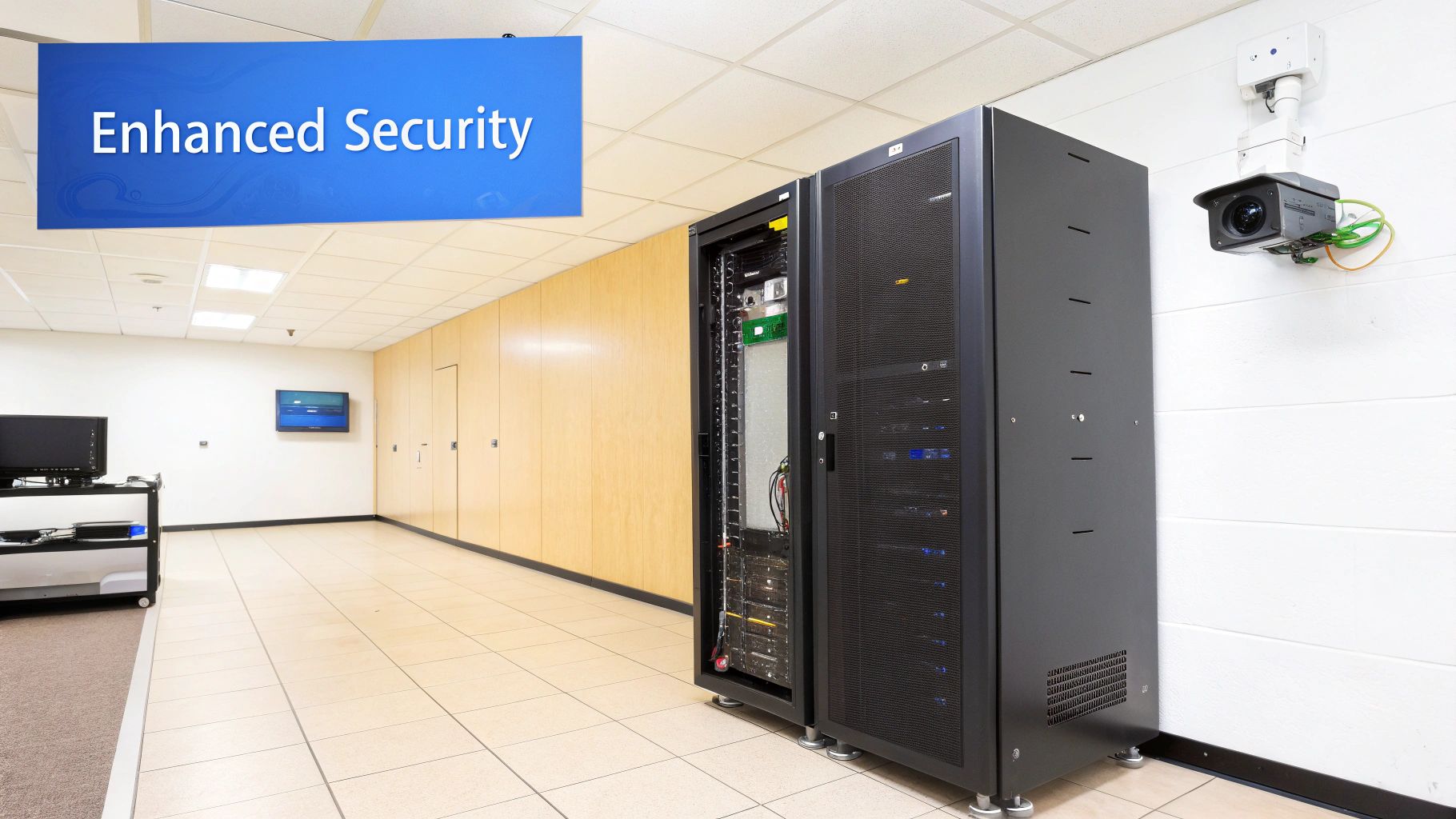
Achieving Total Isolation
This is where a dedicated server changes the game. It completely removes those shared-environment risks by giving you total physical isolation. You are the only one using that machine. Period. This means you don't have to worry about the activities of "noisy neighbors" introducing vulnerabilities. For any application that touches sensitive user data, financial details, or protected health information, that exclusive access is absolutely crucial. For instance, a healthcare app managing patient records would require this level of isolation to help meet HIPAA compliance.
For businesses needing to meet strict compliance requirements like HIPAA or PCI-DSS, the complete physical and network isolation of a dedicated server is often the only acceptable solution. It removes the compliance hurdles and security ambiguities inherent in a multi-tenant environment.
That total isolation gives you something else, too: an incredible amount of control. You have the power to harden the entire server from the bare metal up, customizing every single security setting to fit your exact needs.
Granular Control and Customization
With a dedicated server, the entire software stack and all the hardware are yours to command. This opens the door to highly specific security measures that you just can't implement on a typical VPS.
Some of the key customizations you can make include:
- Custom Firewall Rules: You can build out complex, application-specific firewall policies without hitting any provider-imposed limits. For example, you could configure rules to only allow traffic from your corporate IP range for administrative access, significantly reducing the attack surface.
- Tailored RAID Configurations: Need maximum data redundancy? You can set up specific RAID levels, like RAID 10, to protect against drive failure and boost performance, which is ideal for a database server handling critical transactions.
- Advanced DDoS Protection: Deploying specialized security hardware and fine-tuning network protocols is much more straightforward when you have direct access to the hardware. You can dive deeper into this in our guide to dedicated servers with DDoS protection.
This level of deep-seated control is exactly why dedicated infrastructure is still so popular. The market for dedicated server hosting hit a massive $16.95 billion in 2023 and continues to grow, underscoring its vital role for serious enterprise applications where security is non-negotiable.
Cost, Scalability, and Long-Term Value
When you're weighing VPS vs. dedicated server hosting, the sticker price is often the first thing you see. But to really understand the costs, you have to look past that initial monthly fee and think about the bigger picture—total cost of ownership and long-term value.
VPS hosting is undeniably attractive at first glance. Its low entry cost is perfect for startups, developers spinning up test environments, or websites with traffic that’s all over the map. It's a fantastic, affordable launchpad.
The catch? As your needs grow, so does your bill. The cost to scale up a VPS can get steep, and fast. Pumping more money into CPU, RAM, and storage on a virtual server often hits a point of diminishing returns, where you’re paying more for smaller and smaller performance gains.
The Price-to-Performance Equation
Dedicated servers are a different beast entirely. Yes, the initial monthly cost is higher, but what you get is a much better price-to-performance ratio, especially for workloads that are constantly demanding. You're paying a fixed, predictable price for a huge pool of resources that are 100% yours.
Think of a dedicated server as a strategic investment. You’re buying into stable, high-performance infrastructure. That fixed cost means no surprise bills when you scale, giving you financial predictability that's crucial for growth.
Let's put this into a real-world context. Imagine you're running a fast-growing online gaming community.
- On a VPS: When player numbers spike during peak hours, the server starts to lag. The user experience tanks. You could upgrade the VPS plan, but you're just kicking the can down the road until the next traffic surge forces another costly upgrade.
- On a Dedicated Server: Moving to a bare-metal server gives you an immediate and massive performance boost for one consistent monthly price. With exclusive access to the CPU and network, every player gets a smooth, low-latency experience. That’s how you build a loyal community.
Long-Term Value and Planning for Growth
This gaming example really drives home the long-term value. The fixed cost of a dedicated server lets your business grow into its hardware without getting nickel-and-dimed for every new resource you need. If you want to dive deeper into how these costs break down, check out our guide on dedicated servers prices.
Ultimately, a VPS is an excellent place to start. But once performance becomes directly tied to your revenue and reputation, a dedicated server isn't just a better option—it's the smarter financial choice. It gives you a powerful, stable foundation that actually supports your growth instead of becoming the bottleneck that holds you back.
When a Dedicated Server Is the Right Choice
While a VPS is a fantastic, scalable tool, some situations demand the absolute, no-compromise power that only a dedicated server delivers. The choice to go with bare metal isn't just about needing more resources; it's a strategic decision where performance, stability, and security are directly tied to your bottom line and reputation. In these cases, the vps vs dedicated server hosting debate ends with dedicated hardware coming out on top.
For any application where every millisecond matters and even the slightest performance dip is a deal-breaker, a dedicated server is the only way to go. It gives you a stable, predictable foundation for the work that truly counts.
High-Stakes E-commerce Platforms
Imagine a bustling e-commerce store on Black Friday. A momentary slowdown at checkout means abandoned carts and lost revenue. A dedicated server gives you guaranteed CPU and RAM, so your site stays fast and responsive even under a massive traffic surge. This protects your sales and, just as importantly, your customers' trust.
Mission-Critical SaaS Applications
Software-as-a-Service (SaaS) platforms often rely on complex, heavy-hitting databases. To keep the user experience smooth, they need consistent, lightning-fast I/O performance. A dedicated server armed with high-speed NVMe storage cuts out the virtualization layer you'd find on a VPS, meaning database queries fly with minimal latency. That kind of consistency is crucial for service reliability and for securing customer data in a completely isolated environment.
A dedicated server isn't just about raw power; it's about providing an environment of absolute predictability. When your business model relies on guaranteed uptime and flawless performance, the physical isolation of a dedicated machine removes the variables that can impact a shared platform.
Demanding Online Gaming Communities
Running a large gaming community? Low-latency networking and a beastly CPU are non-negotiable. Lag ruins the game and sends players packing. A dedicated server brings the raw processing power needed for complex game logic and the low-ping network connectivity that makes competitive play fair. It's also often backed by serious DDoS mitigation to keep the server online, no matter what. You can find more details on why this is crucial in our guide to choosing a Linux dedicated server for these kinds of workloads.
Managed Service Providers (MSPs)
For a Managed Service Provider, reputation is everything, and that reputation is built on reliability. By using dedicated servers, MSPs can confidently offer their clients guaranteed performance with strict Service Level Agreements (SLAs). That's a promise that's much harder to keep in a multi-tenant VPS environment, making dedicated infrastructure the bedrock of a trustworthy service.
It's telling that while the cloud VPS market is certainly growing, a staggering 86% of organizations worldwide still rely on dedicated servers for their core operations. This is a clear signal that for many businesses, the potential downsides of a shared environment simply aren't worth the risk to their most critical applications. You can read more about the preference for unwavering performance on Hostiserver.com.
Making the Final Call: Which Server is Right for You?
Choosing between a VPS and a dedicated server isn't just a technical decision; it’s a strategic one. This choice will directly shape your application's reliability, your users' experience, and how easily you can grow down the road. Both are a huge step up from shared hosting, but they are built for fundamentally different stages of a business.
A VPS is a fantastic, budget-friendly starting block for a ton of projects. It’s perfect for development environments, staging servers, or websites with low-to-moderate traffic. If your budget is tight and you can handle minor performance dips from other users on the same hardware, a VPS gives you a solid foundation to build on.
But the second that consistent, peak performance becomes non-negotiable, a dedicated server is the only real answer. The entire VPS vs dedicated server hosting debate pretty much ends when you're talking about mission-critical applications.
A Quick Visual Guide to Your Decision
To make this a bit clearer, let's focus on the key factors that really push a project into dedicated territory. This decision tree walks you through the exact questions you should be asking about your application's real-world demands.
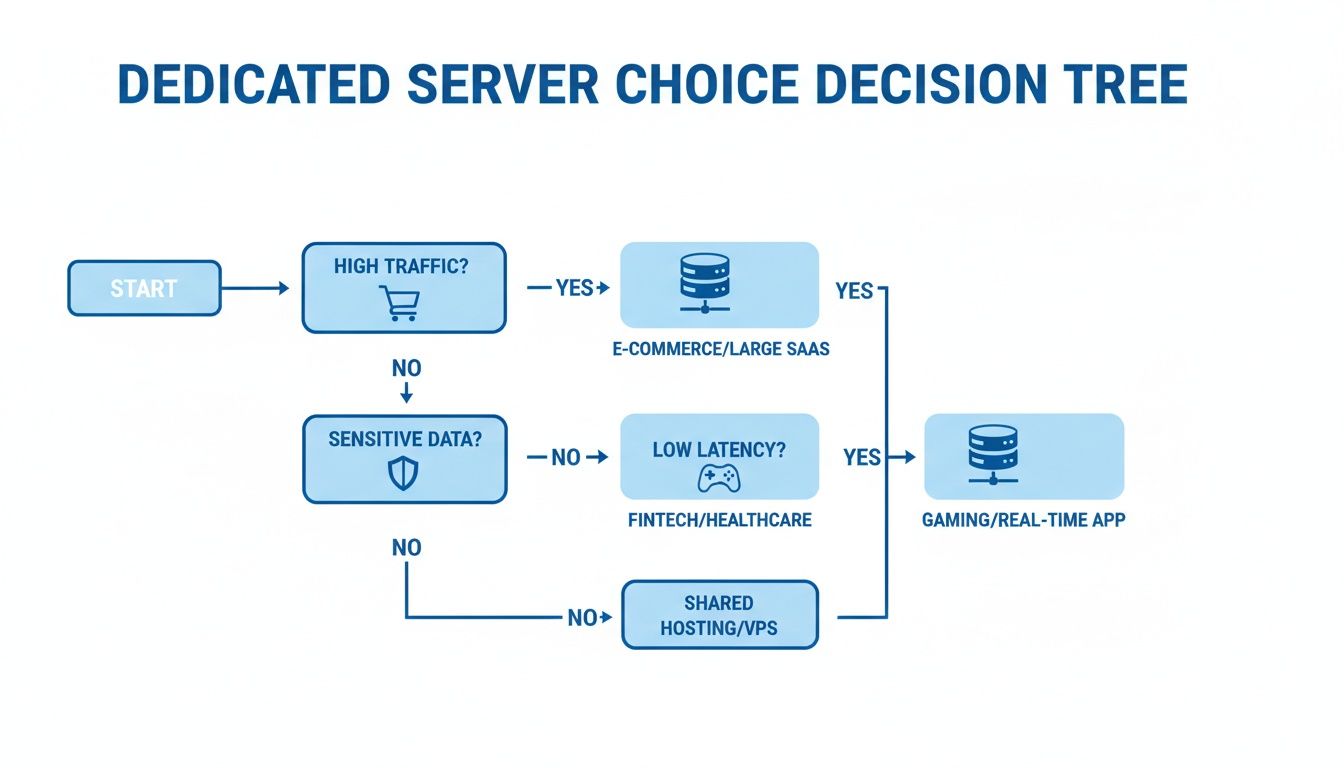
As you can see, if you find yourself answering "yes" to questions about heavy traffic, sensitive data, or the need for ultra-low latency, all signs point to the isolated power of a dedicated server.
This isn't just about picking hardware. It’s an investment in your brand’s reputation and your bottom line. When every second of uptime and every millisecond of speed directly impacts revenue, the raw, uncontested resources of a dedicated server become indispensable.
For established SaaS platforms, high-volume e-commerce sites, and critical enterprise systems, the guaranteed performance of bare metal is everything. It's what ensures your operations run smoothly, stay secure, and can scale up without hitting a ceiling.
At the end of the day, if downtime translates directly to lost customers and lost money, a dedicated server delivers the operational stability—and peace of mind—you absolutely need.
Frequently Asked Questions
Choosing between a VPS and a dedicated server often boils down to a few critical questions about your future needs, technical skills, and management style. Let's get straight to the answers you need to make the right call.
When Should I Upgrade from a VPS to a Dedicated Server?
The most obvious sign it's time to upgrade is when your growth starts to break things. If your website crawls to a halt during peak traffic, or your app's performance feels unpredictable, you're likely pushing the limits of your VPS resources. For example, if your online store's payment processing times out during a flash sale, it's a clear signal you need more consistent power.
Another major trigger is compliance. As soon as your business starts handling sensitive data subject to strict regulations, the isolated environment of a dedicated server isn't just a nice-to-have—it's often a requirement. When the "noisy neighbor" problem or resource caps start costing you customers or putting you at risk, it's time to move up.
Is a Dedicated Server Harder to Manage?
It can be, but it doesn't have to be. An unmanaged dedicated server hands you the keys to the entire machine, meaning you're on the hook for every update, security patch, and monitoring alert. This offers ultimate control, but it requires significant technical expertise. For instance, you would be responsible for patching the operating system against a new vulnerability like Heartbleed or Shellshock yourself.
The alternative is a fully managed dedicated server plan. With a managed solution, the provider’s expert team handles all the heavy lifting—server setup, maintenance, security, and troubleshooting. You get all the power and isolation of your own hardware without the day-to-day management burden.
The choice between managed and unmanaged hosting isn't just about technical skill; it's about focus. It lets you align the server's raw power with your team's core responsibilities, so you're not sidetracked by server administration.
Can I Customize the Hardware on a Dedicated Server?
Absolutely. This is where dedicated servers truly shine. A VPS gives you a fixed slice of a pre-configured machine, but a dedicated server is like building a custom PC for your specific workload.
You get to hand-pick the exact CPU, specify the precise amount of RAM, and design your storage setup from the ground up. Need lightning-fast I/O for a large database? You can build a RAID array with multiple NVMe SSDs for unmatched performance and redundancy. This level of hardware control is impossible in a virtualized environment.
Ready to harness the power of truly dedicated infrastructure? At Soraxus, we provide enterprise-grade bare metal servers with advanced DDoS mitigation and 24/7 expert support to ensure your mission-critical applications achieve peak performance and reliability. Explore our customizable dedicated server solutions at https://soraxus.com.