Unmetered bandwidth dedicated servers: Predictable costs, scalable performance

Soraxus Assistant
January 15, 2026 • 21 min read
Staring at a surprise bill for bandwidth overages feels like getting penalized for your own success. When you're running a SaaS platform, a gaming community, or a high-traffic website, a sudden user spike should be a reason to celebrate—not a source of budget anxiety. This is precisely where unmetered bandwidth dedicated servers come in, offering a smart way to lock in your costs and guarantee performance.
Escaping the Trap of Unpredictable Bandwidth Costs

For any growing business, unpredictable expenses are a killer. A typical metered bandwidth plan, where you pay for every single gigabyte transferred, can turn into a serious financial headache overnight. For example, a successful marketing campaign that drives 100,000 new visitors to your e-commerce store could suddenly rack up thousands of dollars in unexpected fees, effectively punishing you for your growth.
This kind of uncertainty forces you to play defense. You might find yourself delaying scaling, throttling user connections, or holding back on new features—all just to dodge a surprise invoice. That whole approach runs completely counter to the main goal of any online business: attracting and keeping as many users as possible.
The Problem with Metered Plans
Metered plans often box you into a frustrating cycle of budget stress and performance ceilings. When your traffic surges, one of two bad things usually happens:
- Skyrocketing Costs: Your bill climbs right alongside your traffic, making it incredibly difficult to forecast your monthly expenses. Imagine a video streaming service that pays per gigabyte; a single viral video could bankrupt them.
- Performance Throttling: Some hosts will automatically slam the brakes on your connection once you hit a data cap, degrading the user experience at the worst possible moment. Your site becomes sluggish just as it’s getting popular.
The core challenge is simple: Your infrastructure costs shouldn't penalize you for achieving your business goals. Success should be scalable and predictable, not a source of financial stress.
Unmetered bandwidth dedicated servers offer a clear way out of this trap. Instead of paying for data volume, you pay a flat monthly fee for a dedicated network port. This model gives you the financial predictability you need to stop worrying about traffic and start focusing on innovation. You get the confidence that your infrastructure can handle whatever you throw at it without sending your budget off a cliff.
Getting a handle on the costs associated with dedicated servers is the first step toward building a more stable and scalable foundation for your applications. Consider this guide your roadmap to building that foundation.
What "Unmetered Bandwidth" Really Means
The term "unmetered bandwidth" sounds fantastic, right? Like an all-you-can-eat data buffet. But in the real world of dedicated servers, it's less about magic and more about smart, practical engineering. Getting this distinction right is the key to picking a server that actually fits your needs.
Let’s break it down with an analogy I use all the time: think of your server's connection as a highway.
- A metered plan is a classic toll road. Every car (or data packet) that passes through gets counted, and you get a bill for the total. A surprise traffic jam can lead to a shockingly high invoice at the end of the month.
- An unmetered plan is different. It’s like leasing your own private, multi-lane highway for a flat monthly fee. The size of that highway—say, a 10Gbps connection—is your port speed.
On your private highway, you can run as much traffic as you want, 24/7, without ever hitting a toll booth. "Unmetered" refers to the volume of data, which is effectively unlimited. You aren't paying for how many cars use the road, just for how many lanes you've leased.
Your Only Real Limit is the Port Speed
This is the most important takeaway for anyone considering an unmetered dedicated server: you are not buying infinite speed. What you're actually getting is a dedicated, fixed-speed connection with no caps on data transfer. Your performance is defined entirely by your port speed, which acts as the absolute ceiling for how much data you can push or pull at any given moment.
You're paying for the size of the pipe, not for the amount of water flowing through it. A 10Gbps unmetered port means you can consistently use up to 10Gbps of bandwidth, month after month, for one predictable price.
Think about a video streaming platform. With a 10Gbps unmetered port, they can serve thousands of concurrent HD streams without a problem. If their viewership suddenly triples overnight after a viral hit, their monthly hosting bill doesn't budge. The only constraint is the 10Gbps physical capacity of their connection, not some arbitrary data transfer limit.
A Foundation for Global Growth
This predictable model has become absolutely critical as data consumption has gone through the roof. Worldwide interconnection bandwidth is projected to hit an incredible 33,578 Tbps by 2026, driven by a compound annual growth rate of roughly 34% between 2022 and 2026. This is why you see so many SaaS platforms, gaming communities, and high-traffic web hosts moving to unmetered dedicated servers. If you want to dive deeper, you can explore more data on bandwidth trends to see just how massive this growth is.
This flat-rate cost structure gives businesses a stable foundation to build on. Here’s what that looks like in the real world:
- Game Server Hosting: A game host can support thousands of players during a massive weekend event without dreading a five-figure overage bill on Monday morning.
- SaaS Platforms: A software company can onboard a huge new enterprise client, handling terabytes of data uploads, without their service slowing down or their costs spiraling.
- Media Delivery: A content creator can stream 4K video to a global audience, knowing their infrastructure can handle viral success without a financial penalty.
At the end of the day, unmetered bandwidth isn't about limitless speed. It's about limitless potential. It gets rid of the financial surprises tied to growth, giving you the freedom to scale your operations with cost certainty and rock-solid performance.
Choosing Your Bandwidth Model
Picking the right bandwidth model is one of those decisions that can make or break your budget and your application’s performance. It’s not just a line item on an invoice; it's a strategic choice. To really get a feel for what’s at stake, let’s walk through the three main options—Metered, Burstable, and Unmetered—using a real-world scenario.
Picture this: a gaming company is about to launch its next big multiplayer title. After years of hard work, they’re expecting hundreds of thousands of players to storm the servers on day one. How does their bandwidth choice play out?
Metered Bandwidth: The High-Risk Gamble
First up is the classic Metered plan. Here, the company pays for every single gigabyte of data that moves in and out. While that might sound fair and cost-effective for a simple, low-traffic website, it's a ticking time bomb for a major launch.
The moment players start logging on, downloading game files, and sending real-time data packets, the data usage will explode. A massively successful launch could, ironically, trigger a catastrophic bill filled with overage fees. What should be a moment of celebration quickly turns into a financial nightmare. For any business with spiky or unpredictable traffic, the risk is just too high.
Burstable Bandwidth: A Slippery Middle Ground
Then we have the Burstable model, which is often billed using the 95th percentile method. This model gives you a baseline amount of bandwidth but lets you "burst" above it to handle temporary surges. The provider usually ignores your top 5% of usage spikes over the month and bills you based on the next-highest peak.
For our gaming company, this is a step up from a purely metered plan, as it can handle that initial wave of players. The catch? They're still paying a premium for that peak usage. If the game stays popular and traffic remains high for weeks, that "burst" just becomes the new baseline, leading to a consistently expensive and unpredictable monthly bill.
This simple flowchart can help you visualize when to jump from metered to unmetered based on your traffic patterns.
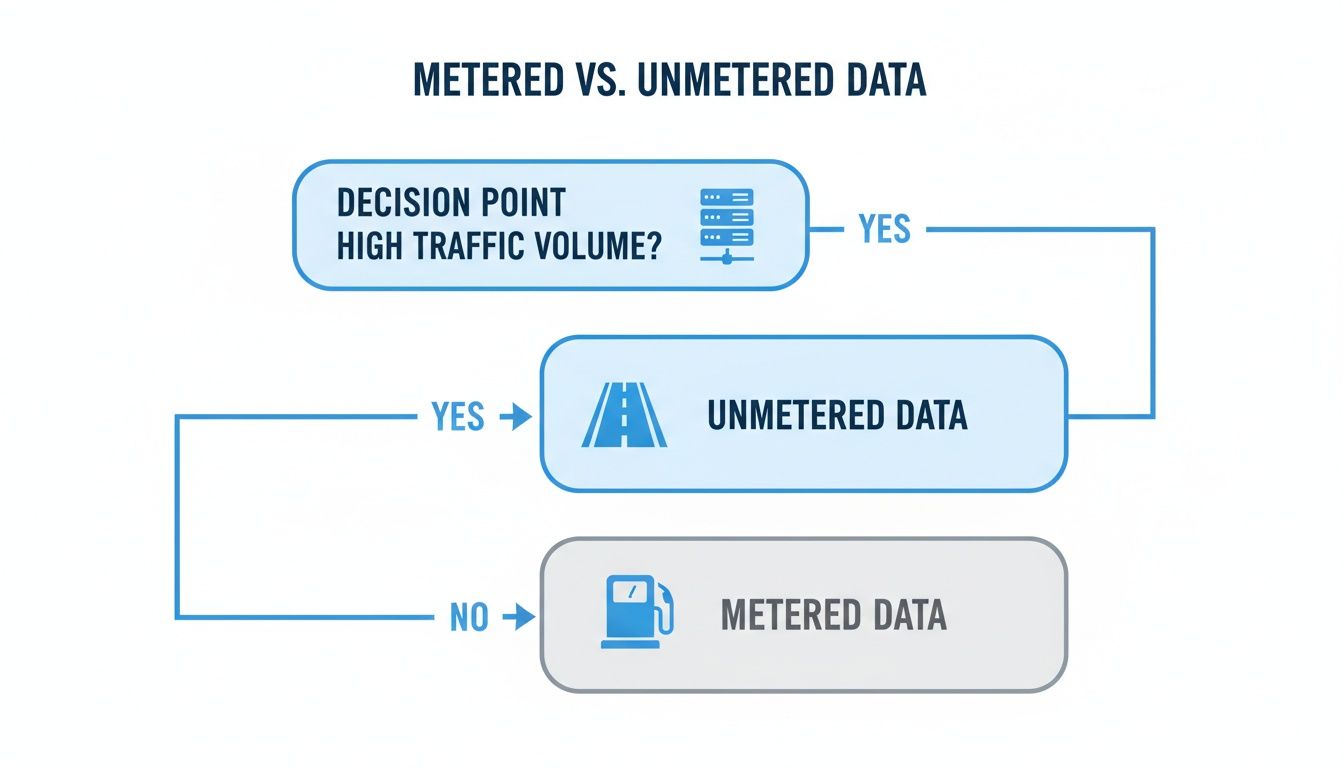
As you can see, once your traffic becomes consistently high, the unmetered path offers the only real predictability for both performance and cost.
Unmetered Bandwidth: The Predictable Path to Scale
This brings us to unmetered bandwidth dedicated servers. With this model, the gaming company pays a flat monthly rate for a dedicated port speed, say 10Gbps. That’s their highway, and they can send as much traffic down it as they want, 24/7, with no data transfer caps.
An unmetered model transforms bandwidth from a variable operational expense into a fixed, predictable cost. This allows you to budget with certainty, no matter how successful your application becomes.
On launch day, it doesn't matter if 1,000 or 100,000 players are online at once—the bill is exactly the same. The company can put all its energy into delivering a great, low-latency gaming experience without worrying that their success will be punished with surprise fees. This financial peace of mind is the true power of an unmetered plan.
A side-by-side comparison really drives home the different trade-offs you're making with each model, especially when the stakes are high.
Bandwidth Model Comparison for a High-Traffic SaaS App
This table breaks down how each model would impact a growing application where traffic is a direct measure of success.
| Feature | Metered Bandwidth | Burstable Bandwidth (95th Percentile) | Unmetered Bandwidth |
|---|---|---|---|
| Cost Structure | Pay-per-gigabyte (GB/TB). | Baseline allowance + fees for peak usage. | Fixed monthly fee for port speed. |
| Predictability | Very Low - Costs scale directly with traffic. | Medium - Hard to forecast peak usage costs. | High - Flat rate offers complete budget certainty. |
| Ideal Use Case | Low-traffic sites, development servers. | Websites with occasional, short-lived spikes. | High-traffic apps, streaming, gaming, SaaS. |
| Primary Risk | Astronomical overage fees from success. | Consistently high bills if traffic remains elevated. | Paying for unused capacity if traffic is low. |
In the end, the right choice comes down to your traffic patterns, how much risk you're willing to stomach, and whether you need a stable, predictable budget. For any business where more traffic means more success, an unmetered dedicated server provides the most solid and financially sane foundation to build on.
Looking Beyond the Bandwidth Number
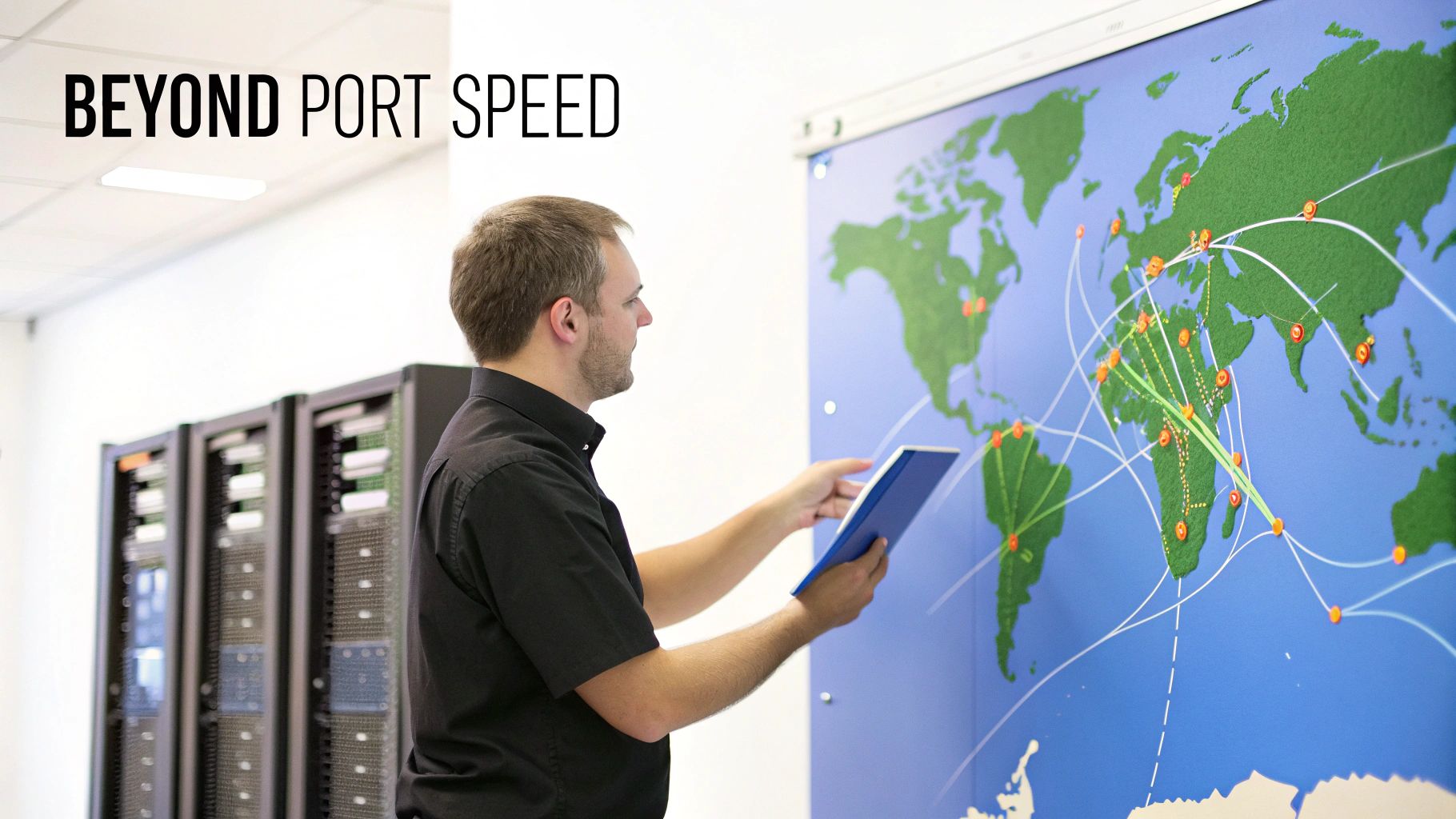
Seeing "10Gbps Unmetered" advertised is tempting, but that number alone doesn't tell you the whole story. The truth is, two providers offering the exact same port speed can deliver wildly different real-world performance.
Think of your 10Gbps port like a freshly paved, multi-lane on-ramp to a highway. The on-ramp is great, but what if it only leads to congested backroads? Your speed is useless. You need that on-ramp to connect directly to major, high-speed interstates.
This is where the network itself—its peering and transit arrangements—becomes the most important factor. These behind-the-scenes details are what separate a premium, high-performance unmetered service from a budget one that will inevitably bottleneck your application.
Understanding Network Peering and Transit
A provider's network quality is all about how well it connects to the rest of the internet. A top-tier provider invests heavily in building direct, high-capacity relationships with other major networks, which has a massive impact on your server's speed and reliability.
Let's use a flight analogy to make this crystal clear:
- Strong Peering: This is like an airline with a hub at a major international airport. It has direct flights (peering connections) to all the other big hubs (Tier-1 carriers, major internet exchanges). Your data gets to its destination fast, with no layovers.
- Poor Peering: This is like a small regional airline. To get your data across the country, it might need to make multiple connecting flights through other networks. Each stop adds delay (latency) and another chance for something to go wrong.
When you're evaluating a provider, you want to see a diverse and redundant "network blend." This simply means they have multiple connections to different upstream carriers. If one connection gets congested or fails, your traffic is instantly and automatically rerouted through another path, with no single point of failure.
The Truth About Fair Use Policies
The term Fair Use Policy (FUP) can be a red flag for some, but for a reputable unmetered server provider, it's actually a sign of quality. A well-written FUP isn't there to sneakily throttle your legitimate traffic; it's there to protect the network for all customers.
A proper Fair Use Policy is a safeguard against abuse. It ensures your mission-critical application isn't sharing a network with someone running a misconfigured script or a resource-hogging crypto miner that degrades performance for everyone.
For instance, a good FUP prevents activities like running an open proxy that generates a constant, massive firehose of junk traffic. This keeps the network clean and ensures the high-quality bandwidth you’re paying for is always available when you need it. Without a solid FUP, one bad actor could saturate shared links, causing slowdowns and packet loss for every other customer.
These details matter immensely. A robust network, for instance, is the bedrock of effective security. As we cover in our guide to dedicated servers with DDoS protection, network capacity is a critical part of absorbing attacks. In the end, a great unmetered service is never just about port speed—it’s about the quality, resilience, and smart management of the network behind it.
Who Wins With Unmetered Dedicated Servers
Knowing the specs of unmetered bandwidth is one thing. Seeing how it solves real-world problems is where it really clicks. For some businesses, having high-capacity, predictable bandwidth isn't just a perk—it’s the engine that keeps their entire operation running and growing.
Let’s look at who benefits the most from investing in unmetered bandwidth dedicated servers and see how that choice directly affects their revenue and customer experience. This is about connecting a technical feature to a real business advantage.
High-Traffic, Low-Latency Gaming Communities
If you're hosting a game server, your success is measured in milliseconds. Lag is the ultimate fun-killer. A split-second delay can be the difference between a win and a loss, and frustrated players will jump ship to a more stable server in a heartbeat.
This is exactly where unmetered bandwidth shines. It gives a host the power to support thousands of players at once, all sending and receiving a constant flood of data, without ever hitting a cap that throttles performance.
- Business Challenge: A new game release brings 50,000 concurrent players, causing massive data spikes.
- Unmetered Solution: A 10Gbps port handles the load without throttling or generating overage fees.
- Outcome: A rock-solid, lag-free gaming environment that builds a loyal community and drives revenue through in-game purchases.
Mission-Critical SaaS Platforms
Software-as-a-Service (SaaS) companies live and die by uptime and speed. Customers expect a snappy interface, whether it's a slow Tuesday morning or the mad dash of end-of-quarter reporting. A slow-down isn't just an annoyance; it causes customers to leave and tarnishes a brand's reputation.
Unmetered dedicated servers provide the solid foundation these platforms need. They can absorb huge, unpredictable traffic spikes—from a massive new client importing years of data to a feature suddenly going viral—all for one flat monthly fee.
For a SaaS business, an unmetered server transforms bandwidth from a volatile operational cost into a predictable, fixed expense. This allows for accurate financial forecasting and eliminates the risk of being penalized for growth.
This setup is far better suited for performance-critical applications than a virtualized environment, where a "noisy neighbor" could drag down your app. To get a better sense of why this matters, you can compare the specifics of dedicated servers vs VPS solutions and see why dedicated resources are so crucial.
High-Resolution Media Streaming Services
Picture a media company broadcasting a global event live in 4K. Their entire business is built on delivering a perfect, high-quality stream to thousands, or even millions, of viewers at the same time. Buffering, pixelation, or dropped connections just aren't an option. Each viewer is pulling a heavy, continuous stream of data, and the total demand is immense.
An unmetered model is really the only way this works. The company pays for its 10Gbps or 40Gbps port and can push out as much video as its audience demands, never once thinking about data transfer bills. This lets them focus on creating great content, knowing their infrastructure can handle the load.
In reality, unmetered bandwidth has become the standard for these demanding workloads. A typical modern setup for a small streaming service might include a 10Gbps port paired with fast NVMe SSDs capable of high read speeds, ensuring video files can be delivered to the network without a storage bottleneck. This combination is a key reason why the dedicated server market is projected to grow substantially in the coming years. You can learn more about the surge in dedicated server demand to get a handle on these market trends. Each of these examples shows how unmetered bandwidth solves a specific business problem, turning a simple server spec into a powerful competitive edge.
How to Select the Right Provider

Choosing a provider for an unmetered dedicated server is about so much more than just the advertised port speed and monthly price. What really separates a solid partner from a future liability is buried in the details of their network infrastructure and the quality of their support. Ultimately, you're looking for a provider whose network is as reliable as the hardware they give you.
This isn't a decision to take lightly. Your choice will directly impact your application's performance, stability, and even its security. A provider with a shaky network or sluggish support can easily negate the benefits of a top-of-the-line server. Let's walk through a practical checklist to help you evaluate the things that truly matter.
Evaluating DDoS Mitigation Capabilities
Let's be clear: not all DDoS protection is the same, and having robust mitigation is non-negotiable for any serious online business. Many providers offer basic protection that only handles simple volumetric attacks—the kind that just tries to overwhelm your connection with junk traffic. That’s a start, but it leaves you wide open to smarter attacks.
You need to find a provider offering comprehensive, multi-layered protection. This means they can defend your server across network Layers 3 through 7. True protection can stop:
- Volumetric Attacks: The brute-force floods designed to saturate your bandwidth.
- Protocol Attacks: Sneakier attacks that exploit weaknesses in network protocols like TCP.
- Application-Layer Attacks: The most sophisticated threats, which target specific vulnerabilities in your website or application code (like overwhelming your login page with fake requests).
Think about a gaming server. It needs a system smart enough to tell the difference between a sudden surge of legitimate players and a botnet trying to take it offline. That requires intelligent, application-aware filtering, not just a simple traffic dam.
Analyzing SLAs and Support Quality
A Service Level Agreement (SLA) is the provider's official promise on uptime and network performance. A 99.99% network uptime SLA looks great on paper, but you need to dig into what it really guarantees. What happens if they fail to meet that promise? Are the service credits meaningful, or just a token gesture?
The quality of their support is equally critical. When something inevitably goes wrong, you need access to experts who can fix it fast.
Look for providers that are transparent about their support metrics. Publicly stated average response times—such as a 15-minute average response—are a strong indicator of a well-staffed, efficient support team.
Also, make sure out-of-band management (OOBM) is on the feature list. This gives you a separate, secure backdoor to your server, letting you get in even if the main network connection is dead or the OS has crashed. For example, you could remotely power cycle the machine or access the BIOS to fix a boot issue without needing to file a support ticket.
The Network Footprint and Financial Sense
A provider’s global network and peering arrangements aren't just marketing filler; they have a direct impact on your users' experience. A well-peered network with data centers in multiple locations lets you position your server closer to your audience, which is the key to cutting down latency and making your application feel snappy.
Beyond the tech, the numbers often tell a compelling story. The cost efficiency of unmetered bandwidth dedicated servers is one of their biggest selling points. For an e-commerce site handling 100,000-200,000 monthly visitors, a comparable cloud VPS setup could easily cost $1,400 a month. By switching to a dedicated server with 8-16 cores, 64-128GB of RAM, and fast NVMe storage, that cost can drop to just $200-300.
That’s a potential monthly saving of up to $1,200, or $14,400 over a year. You can discover more insights about cloud vs dedicated server costs to see a full breakdown. When you combine that kind of financial stability with superior, uncontended performance, the choice becomes pretty clear for any growing business.
Frequently Asked Questions
When you're digging into the world of unmetered bandwidth dedicated servers, a few questions always seem to pop up. Let's clear the air and get you the straightforward answers you need to pick the right infrastructure for your business.
Is Unmetered the Same as Unlimited Bandwidth?
This is probably the most common point of confusion, and the difference is huge. While marketing departments often use these terms interchangeably, they mean very different things from a technical standpoint.
-
Unmetered Bandwidth: This is about the pipe, not the water. You get a network port with a fixed speed—say, 1Gbps or 10Gbps—and you can push as much data through it as possible, 24/7. You aren't billed for the amount of data transferred, only for the port speed itself. It’s like having a water main of a certain size; you can run it full-blast all month long without paying per gallon.
-
Unlimited Bandwidth: This term should always make you skeptical. It's usually a marketing gimmick that comes with some serious strings attached, often hidden in a fair-use policy. After you hit a certain data threshold, your provider might start throttling your connection speed, leaving you in the slow lane right when you need performance the most. A true unmetered plan gives you a consistent, predictable speed with no data caps.
How Do I Estimate the Port Speed I Need?
Figuring out the right port speed is more of an art than a science, but you can get pretty close by looking at your current usage. Fire up your monitoring tools and find your peak traffic. If you're consistently hitting 500Mbps during your busiest times, a 1Gbps port is a smart move. It gives you plenty of breathing room for daily spikes and future growth.
A good rule of thumb is to choose a port that can comfortably handle at least double your current peak usage. This provides a buffer for growth and prevents performance bottlenecks during demand surges.
If you’re running something more intense like a video streaming platform, a large gaming community, or your own content delivery network (CDN), you should probably be looking at a 10Gbps port as your starting point. When it comes to network capacity, it's always better to have too much than not enough. A good provider can walk you through your traffic patterns and help you find that sweet spot between performance and cost.
Will a 10Gbps Port Always Deliver 10Gbps Speed?
In a word, no. That 10Gbps figure represents the maximum speed of the physical connection between your server and the provider's network switch. Think of it as the on-ramp to the internet highway.
Your actual real-world speed—the throughput your users experience—depends on what happens after that on-ramp. It’s influenced by the provider's total network capacity, who they connect (or "peer") with, and all the network hops between your server and your end-users. This is precisely why choosing a host with a high-quality, well-connected global network is non-negotiable for unmetered bandwidth dedicated servers. You can have the best on-ramp in the world, but if it leads to a congested highway, you're not going anywhere fast.
Ready to eliminate surprise overage fees and secure predictable performance? At Soraxus, we provide enterprise-grade dedicated servers with true unmetered bandwidth, backed by advanced DDoS protection and 24/7 expert support. Explore our high-performance server solutions and build your infrastructure on a foundation of stability and scale.