Your Guide to Linux Managed Services for Enterprise Growth

Soraxus Assistant
December 26, 2025 • 21 min read
When you hear "Linux managed services," what should come to mind isn't just a support hotline. Think of it as handing over the keys to your Linux infrastructure to a team of dedicated experts who handle the day-to-day grind of administration for you. It’s a partnership that takes the complex, often tedious, tasks of server management—things like security patching, performance tuning, and constant updates—off your plate. The whole point is to turn a powerful but demanding OS into a stable, secure, and reliable foundation for your business.
What Are Linux Managed Services Anyway?
Let's use an analogy. Imagine your mission-critical Linux server is a high-performance race car. If you're running it yourself, you’re not just the driver; you're also the mechanic, the engineer, and the entire pit crew. You're in charge of refueling (installing updates), constantly checking the engine (monitoring performance), and making sure the car is safe and secure before every single race. It's an all-consuming job that distracts you from what really matters: winning.
This is exactly where Linux managed services come into the picture. Instead of you juggling every technical detail, a specialized team of experts takes over the complete maintenance and optimization of your infrastructure. For example, instead of your developer spending hours diagnosing a sudden spike in server load, the managed team gets an automated alert, identifies a runaway database query, and resolves it before your customers even notice a slowdown. This lets your own team stop putting out fires and reacting to problems, freeing them up to focus on innovation and pushing the business forward.
More Than Just a Support Hotline
It’s really important to draw a line between managed services and traditional, reactive IT support. The old break-fix model is simple: you wait for something to go wrong, then you call someone to fix it. That approach almost always leads to painful and expensive downtime. A managed service, on the other hand, is all about being proactive and preventing those problems from happening in the first place.
A managed service provider should feel like a natural extension of your own team. Their job isn't just to fix what's broken. It's to keep the underlying systems so well-maintained, secure, and optimized that failures become a rare event, not a daily crisis.
This proactive approach is becoming non-negotiable as Linux environments get bigger and more complex. The Linux market itself is booming, valued at USD 22.38 billion in 2024 and expected to skyrocket to USD 101.05 billion by 2032. With Linux powering over 57.8% of the world's websites, the demand for specialized expertise to manage it all is at an all-time high. You can dive deeper into these trends by checking out the Linux market's powerful growth on 360iresearch.com.
What This Partnership Actually Delivers
At the end of the day, a managed services relationship is about getting consistent, predictable results for your business. Instead of shouldering the entire operational burden yourself, you get a team that provides:
- Proactive Maintenance: A systematic approach to applying patches and updates to shut down security holes before they can be exploited.
- Constant Oversight: 24/7 monitoring of your server's health to catch and fix issues long before your users ever notice them.
- Deep Expertise: Access to the skills of certified Linux engineers without the hefty price tag of hiring them full-time.
- Strategic Peace of Mind: The confidence that comes from knowing your core infrastructure is stable, secure, and ready to scale with your business.
What’s Actually Included in a Managed Linux Service?
When you sign up for managed Linux services, you're not just buying a single product. You're bringing a team of experts on board. Think of it as a comprehensive suite of services, all working in concert to keep your servers secure, stable, and running at peak performance. It’s the difference between reacting to problems as they happen and proactively preventing them from ever occurring.
This partnership is designed to extend your own team's capabilities, bridging the gap between your business goals and the deep technical know-how needed to maintain a rock-solid Linux environment.
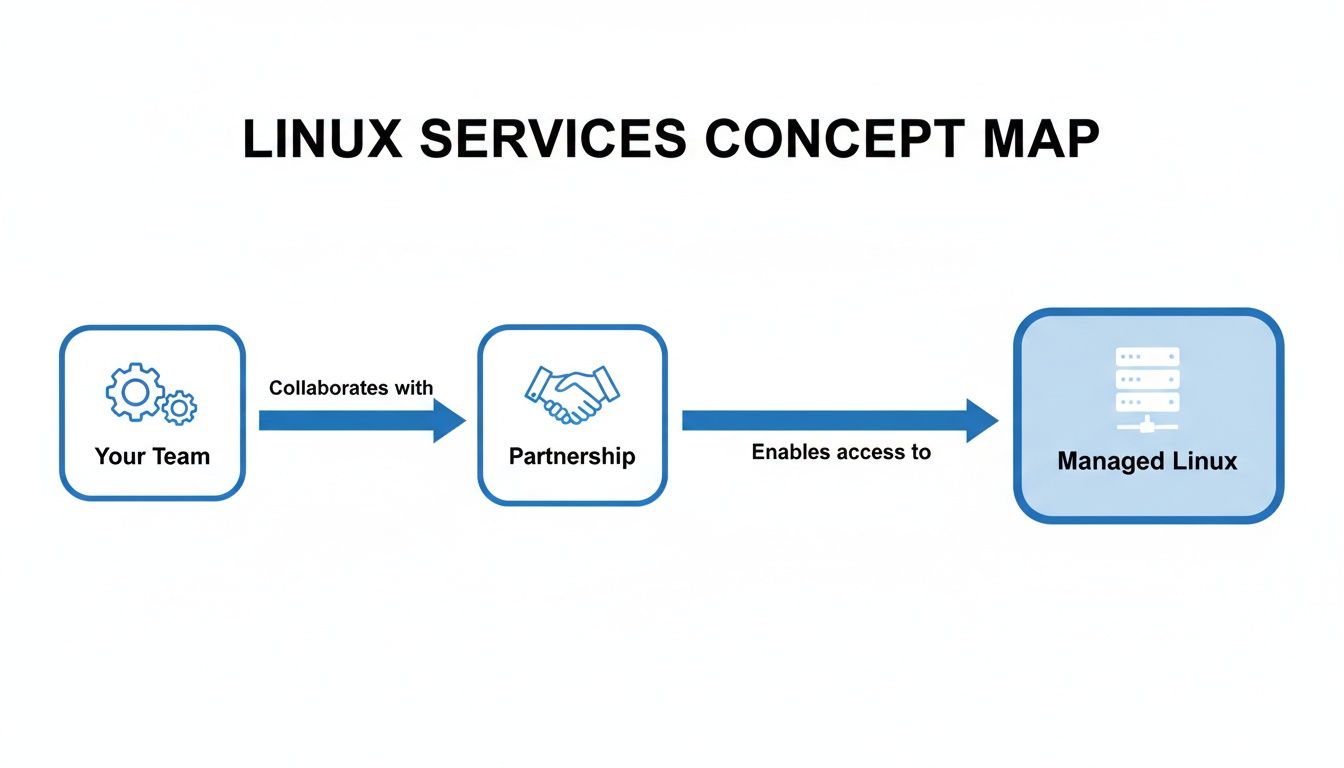
Let's pull back the curtain and look at the core components that make this partnership so valuable.
Proactive Patch Management
Leaving systems unpatched is like leaving your front door unlocked. It's one of the most common ways attackers get in. Proactive patch management is far more than just running an update command now and then. It’s a disciplined, systematic process.
When a critical vulnerability like "Log4Shell" hits the news, a managed services team doesn't wait. They immediately scan every client server to see who's exposed, test the necessary patches in a safe staging environment, and then carefully roll them out to production. This approach closes dangerous security holes long before they can be exploited, all without disrupting your applications.
24/7 Performance Monitoring
Your servers don't sleep, and your monitoring shouldn't either. 24/7 performance monitoring means using sophisticated tools to keep a constant watch on vital signs like CPU load, memory usage, disk activity, and network traffic. But it's not about staring at graphs—it's about intelligent alerting.
Imagine a slow memory leak in your SaaS application. Your internal team might not notice it until the server crashes right in the middle of a busy workday. A managed monitoring service, on the other hand, would spot the unusual memory trend, alert an engineer, and allow them to schedule a quick reboot during a quiet maintenance window. The result? A major outage is completely avoided.
Automated Backups and Disaster Recovery
For any modern business, data is everything. Protecting it is non-negotiable. Managed services set up robust, automated backup systems that create regular, verified copies of your data. For instance, they might configure daily incremental backups of your database and weekly full snapshots of the entire server, storing them securely in a geographically separate location. This includes full system snapshots that enable a quick, complete restoration if hardware fails, data gets corrupted, or you're hit by a cyberattack.
A disaster recovery (DR) plan is more than just having backups; it's a tested, actionable strategy. A managed provider ensures your backups are not only successful but also restorable, regularly performing test recoveries to validate data integrity and confirm recovery time objectives (RTOs) can be met.
Advanced Security Hardening
A standard Linux installation is a great starting point, but it's nowhere near secure enough for an enterprise workload. Advanced security hardening is the meticulous process of locking down the operating system to shrink its "attack surface." This is all about building a multi-layered defense.
This hardening process almost always includes:
- Configuring Firewalls: Setting up strict firewall rules with tools like
iptablesorfirewalldto permit only essential traffic, such as allowing web traffic on ports 80 and 443 while blocking all other inbound connections. - Disabling Unused Services: If a service isn't needed, it's turned off. For example, a web server has no need for an FTP service, so it is disabled to close a potential backdoor.
- Enforcing Strong Access Controls: This means requiring strong passwords, mandating SSH key-based logins, and tightly restricting root access using
sudorules. - Intrusion Detection Systems: Deploying tools that watch for suspicious activity—like repeated failed login attempts from a single IP address or unauthorized changes to critical system files—and sound the alarm.
Configuration Management and Remote Access
Consistency across your server fleet is the secret to stability. Configuration management tools like Ansible or similar automation platforms automate server setup and maintenance, ensuring every server is a perfect clone of the last. For example, if you need to deploy ten new web servers, an automated playbook can install the OS, harden security, configure the web server software, and deploy your application code identically on all of them in minutes. This eliminates "configuration drift" and makes scaling your infrastructure a breeze.
Finally, you need a reliable way to get in when things go wrong. Managed providers offer Out-of-Band (OOB) management tools like IPMI or KVM over IP. This gives engineers direct, BIOS-level access to the server that works even if the operating system has crashed or the network is down. They can remotely reboot a frozen server and fix the problem as if they were standing right in front of it. While OOB is a game-changer for dedicated hardware, the approach differs for virtual environments. You can learn more by comparing the details in our guide on dedicated servers vs VPS hosting. This level of access guarantees that any issue can be resolved quickly, no matter what.
Unmanaged vs Managed Linux Services: A Clear Comparison
To put it all into perspective, here’s a quick breakdown of who handles what. This table shows the stark difference in responsibilities—and outcomes—between going it alone and partnering with a managed services provider.
| Responsibility | Unmanaged Server (In-House Team) | Managed Linux Services |
|---|---|---|
| Initial Setup | You install and configure the OS, software, and security from scratch. | The provider handles expert OS installation and hardening. |
| Security & Patching | Your team must track vulnerabilities and manually apply patches. | A dedicated team proactively patches and hardens the system. |
| Monitoring | You set up, configure, and respond to your own monitoring alerts. | 24/7 expert monitoring detects and resolves issues, often before you know they exist. |
| Backups | You are responsible for configuring, testing, and managing backups. | Automated, verified backups and a tested disaster recovery plan are included. |
| Troubleshooting | When something breaks (even at 3 AM), it's on your team to fix it. | A 24/7 support team is always on standby to resolve issues. |
| Expertise | Requires hiring and retaining expensive in-house Linux specialists. | You gain immediate access to a team of seasoned Linux experts. |
As you can see, the managed approach offloads the complex, time-consuming, and mission-critical tasks, freeing your team to focus on what truly drives your business forward.
The Real Business Impact of Managed Linux
Let's move past the technical nuts and bolts. The real value of managed Linux services isn't just about outsourcing tasks; it's measured in tangible business outcomes—stronger security, better efficiency, and smarter cost control. It’s about flipping the script from just "keeping the lights on" to building a competitive advantage.
When you partner with a managed services provider, you’re fundamentally shifting your operational model. You're turning your infrastructure from a constant source of headaches and late-night calls into a stable, predictable foundation for growth.

Enhanced Security and Compliance
For any business handling sensitive data, security is far more than a firewall. It's a continuous, demanding commitment to meeting rigid regulatory standards. This is where enhanced security and compliance becomes one of the most significant benefits of a managed partnership.
Imagine your company processes credit card payments. You’re on the hook for PCI DSS compliance. A managed services team doesn’t just install some security tools and call it a day. They implement and document the very controls auditors look for—configuring systems to log every access attempt, running regular vulnerability scans, and applying critical patches on a strict schedule. They build an environment designed to pass an audit, protecting you from crippling fines and brand damage.
This level of security is a continuous process, not a one-time setup. It involves having experts who live and breathe security, constantly adapting your defenses to new threats and ensuring your configurations align with industry best practices.
The same goes for a healthcare organization navigating HIPAA. A managed provider ensures that server configurations, data encryption, and access controls all meet the strict requirements for protecting patient information. This proactive security posture is non-negotiable, and you can dive deeper into these strategies with these essential network security best practices.
Increased Operational Efficiency
One of the first things you’ll notice is the newfound freedom for your internal IT and DevOps teams. The day-to-day grind of server maintenance—patching, monitoring, troubleshooting—is absolutely necessary but delivers very little strategic value. It’s a time sink that pulls your best people away from work that actually drives revenue.
Increased operational efficiency means your senior engineers can finally stop putting out fires and start building what's next. Instead of a DevOps lead spending half their week chasing a performance bottleneck on a web server, they can be automating your deployment pipeline to shorten your release cycles. It’s about letting your team operate at a higher level, where their work directly impacts business growth.
Predictable Cost Optimization
Managing a Linux environment in-house is a recipe for unpredictable spending. One emergency, like a critical hardware failure or a security breach, can blow your budget with unexpected costs for consultants and overtime. Managed services replace this chaotic, reactive spending with a predictable operational expense.
A fixed monthly fee gives you access to an entire team of experts and a suite of powerful management tools for a fraction of what it would cost to build that capability internally. Think about it: the salary for just one senior Linux administrator can easily top six figures. A managed service provides the collective knowledge of a whole team for less, smoothing out your budget and removing the financial shock of an IT crisis.
Immediate Access to Specialized Expertise
Good Linux engineers are hard to find and even harder to keep. The demand is intense, fueled by Linux's sheer dominance in the server market. As of September 2025, Linux runs 57.8% of all identifiable websites worldwide.
The market reflects this reality. The open-source service industry is projected to explode from USD 37.96 billion in 2025 to USD 81.37 billion by 2030. This growth is happening as 85% of enterprises admit they’re struggling to manage complex container workloads. The talent gap is real.
When you bring in a managed service provider, you get access to specialized expertise on day one, without wading into a brutal hiring market. This gives you a serious leg up, ensuring your infrastructure is in the hands of seasoned pros who are already up to speed on the latest tech and security threats.
How Top Companies Use Managed Linux
The real value of managed Linux services shines when you see them solving real-world problems. For many companies, these services aren't just an IT convenience; they're a strategic advantage that lets them tackle intense technical challenges while staying focused on what they do best. Let's look at how leading businesses in demanding industries put these services to work.

SaaS Platforms and Unpredictable Traffic
Software-as-a-Service (SaaS) companies live and breathe uptime. If you run a CRM or a project management tool, just a few minutes of downtime can break customer trust and send them looking for alternatives. The biggest headache is often unpredictable traffic—a killer marketing campaign goes viral, and suddenly server load skyrockets.
This is where a managed services provider steps in, architecting an infrastructure that's both highly available and instantly scalable.
- Proactive Monitoring: Instead of reacting to problems, engineers are always watching performance metrics. For example, if database queries start taking longer than 200 milliseconds, an alert is triggered so an expert can investigate and optimize the query before users experience a slowdown.
- Automated Scaling: The environment is built to automatically spin up more resources when demand surges and then scale back down when things quiet down. This keeps performance snappy without breaking the budget.
- Guaranteed Uptime: A solid 99.99% uptime SLA isn't just a promise; it's a financial commitment from the provider to keep the platform online, giving the SaaS company true peace of mind.
Ultimately, this frees up the SaaS company's development team to work on creating new features, not firefighting server issues.
Game Server Hosting and Low-Latency Performance
In online gaming, every millisecond is critical. Lag is the enemy, and a smooth, responsive experience is absolutely essential for keeping players engaged. Game server hosts are constantly fighting a two-front war: delivering the lowest possible network latency while fending off powerful DDoS attacks aimed at kicking players offline.
Managed Linux services are fundamental to building a competitive gaming platform.
For game hosting, the infrastructure isn't just a server—it's part of the product. The provider's ability to deliver low-latency connectivity and absorb massive DDoS attacks directly translates into a better player experience and a stronger community.
Providers who specialize in this area take a unique approach. They use globally optimized networks to keep ping times down and deploy industrial-strength, always-on DDoS mitigation that can fend off multi-terabit attacks. This kind of protection automatically scrubs malicious traffic in seconds, so legitimate players stay connected and the game never stops.
E-commerce Stores and Secure Transactions
For any e-commerce business, security and compliance are the foundation of everything. You're handling a constant stream of transactions and protecting sensitive customer data like credit card numbers. A data breach isn't just a technical problem; it's a business catastrophe that can result in huge fines and destroy your brand's reputation.
A managed provider takes on the responsibility of creating and maintaining a secure, compliant environment tailor-made for commerce. They handle the systematic hardening of the Linux OS, configure firewalls according to strict best practices, and manage security patches to ensure compliance with standards like PCI DSS. For example, they might implement file integrity monitoring that alerts them the instant a critical system file is changed, helping to detect a potential breach in real time.
By offloading this heavy security burden, the e-commerce store can concentrate on what drives growth: merchandising, marketing, and creating a fantastic customer experience.
Choosing the Right Managed Services Partner
Picking a provider for your managed Linux services is one of the most important infrastructure decisions you'll make. This isn't just about outsourcing tasks; it's about entrusting a core part of your business to a partner. To get it right, you have to look beyond the flashy marketing and scrutinize the details that really matter.
The demand for this kind of expertise is exploding. As Linux continues to dominate high-performance computing, the managed services market is booming along with it. The open-source services market is projected to jump from USD 37.96 billion in 2025 to a staggering USD 81.37 billion by 2030, with managed services growing at a 17.9% CAGR. This rush is largely driven by the 85% of companies that admit they're struggling to manage containers on their own, making it clear just how badly specialized skills are needed. You can learn more about the CentOS statistics and open-source market trends on electroiq.com.
Decoding Service Level Agreements
A Service Level Agreement (SLA) is your contract, the document that holds your provider accountable. But not all SLAs are created equal. It's easy to get fixated on a big uptime number like 99.99%, but that figure can be misleading. A server can technically be "up" while performing so poorly that it's completely unusable for your customers.
The real gold is in the response time guarantees—specifically, the time it takes to get a qualified engineer on your problem.
- Initial Response Time: How fast will a real, certified human being acknowledge your ticket? A 15-minute response guarantee is a great sign of a well-staffed, 24/7 operation.
- Time to Resolution: This is tougher to guarantee, but it's worth asking about their average fix times for common issues. It says a lot about the team's depth of knowledge and efficiency.
An SLA should be a guarantee of expert engagement, not just a promise of network availability. The critical question is: how long will it take for a real Linux expert to start working on your problem, especially at 3 AM on a holiday?
Verifying Security and Compliance Certifications
When it comes to security, trust needs to be earned and, more importantly, verified. A provider's claims mean nothing without independent proof. Look for certifications that match your industry's specific regulatory needs. These audits confirm that a provider has the right controls in place to protect sensitive data.
Key certifications to look for include:
- SOC 2 Type II: This isn't a one-time snapshot. It's a detailed report that validates a provider's controls over an extended period, covering security, availability, and confidentiality.
- ISO 27001: This is the international gold standard for information security management, proving they have a systematic, repeatable process for protecting data.
- PCI DSS: If you handle any credit card transactions, this is non-negotiable. It ensures the provider maintains a secure environment for payment data.
These aren't just logos to put on a website; they are hard evidence of a mature and serious security posture.
Evaluating Support Accessibility and Expertise
In a real emergency, the last thing you want is to fight your way through a generic help desk, only to wait for an escalation. The true value of Linux managed services comes down to having direct access to the people who can actually fix things.
Be direct when you talk to potential providers. Ask them about their support team. Are their engineers in-house? Are they available 24/7/365? Or do they hand off support to a third party after business hours? A provider that invests in its own round-the-clock team of certified Linux experts is showing a genuine commitment to its clients.
The best partners make sure the person who answers your call or picks up your ticket has the skills to start troubleshooting right away. This kind of deep, integrated support is a cornerstone of a great managed services partnership. It's what separates a basic commodity service from a true operational asset.
Answering Your Questions About Managed Linux
Making the switch to a managed Linux service is a big decision, so it's only natural to have a few questions. Let's clear up some of the most common ones we hear from businesses before they jump in.
Managed Hosting vs. Managed Services: What's the Real Difference?
People often toss these terms around as if they mean the same thing, but they really describe two very different kinds of partnerships. Managed hosting is mostly about the hardware. The provider takes care of the physical server, the network, and the power, but everything from the operating system up is your problem.
On the other hand, Linux managed services go way deeper. Here, the provider takes ownership of the entire software stack. They're handling kernel patches, locking down security, tuning your web server for better performance, and more. It’s a complete hands-on approach for the entire software environment, not just the metal it runs on.
Will I Still Have Control Over My Server?
This is a big one. Nobody wants to feel locked out of their own systems. A good managed services provider gets this and won't take away the keys to your kingdom.
The point of a managed partnership isn’t to remove your control—it’s to add to your team’s capabilities. The best providers will always give you full root access. This lets your developers deploy code and make changes whenever they need to, while their experts handle the heavy lifting in the background.
It's truly the best of both worlds: you get total administrative freedom backed by a team of experts making sure everything runs smoothly.
How Painful is the Migration Process?
Moving to a new provider sounds like a headache, but a seasoned team follows a well-defined playbook to keep the process smooth and your downtime near zero. Every migration has its own quirks, but it generally follows these steps:
- Discovery & Planning: First, the provider's team sits down with you to get the lay of the land—your current setup, your apps, and your performance goals.
- Building the New Home: They build a fresh, optimized server environment from scratch, applying best practices for security and speed.
- Syncing Your Data: Your data is securely copied over to the new environment. They'll keep it in sync until the final switch.
- Test Drive: You get to kick the tires and test everything thoroughly in the new setup before any customers see it.
- The Final Cutover: During a planned low-traffic window, the DNS records are updated. Your traffic starts hitting the new server, and the migration is complete.
Are Managed Services Just for Big Companies?
Not even close. While enterprises certainly rely on them, Linux managed services are built to scale. In fact, startups and small businesses often get the most bang for their buck. They instantly gain an entire team of senior-level sysadmins for less than what it would cost to hire just one in-house. As you grow, the service simply scales with you.
Ready to hand off the headaches of server management and get back to growing your business? Soraxus delivers enterprise-grade dedicated infrastructure paired with expert 24/7 support and powerful DDoS mitigation, ensuring your critical applications are always online and running fast. Explore our managed solutions today.