Unlocking Your Carrier Neutral Data Center Benefits

Soraxus Assistant
January 11, 2026 • 20 min read
The big wins with a carrier-neutral data center boil down to three things: more flexibility, lower costs, and better network performance. By bringing a competitive marketplace of network carriers together under one roof, these facilities let you pick and choose the best services for your specific needs, so you’re never locked into a single provider.
What Exactly Is a Carrier Neutral Data Center?
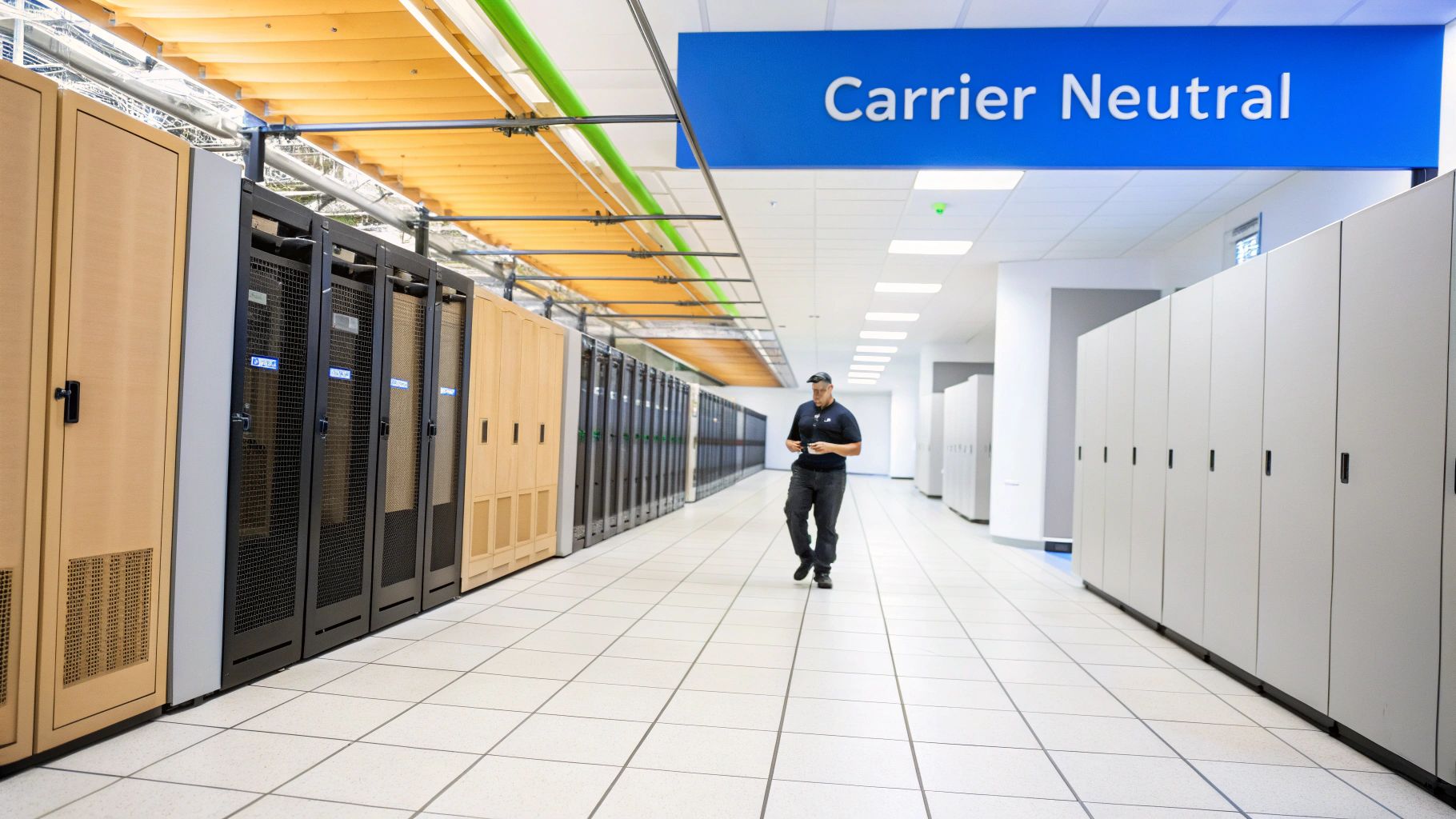
Imagine your IT infrastructure is a global shipping operation. A traditional data center, tied to one network provider, is like a port owned by a single shipping company. You're stuck with their routes, their schedules, and their prices, period.
A carrier-neutral data center is totally different—it’s more like a huge international airport. Inside, you’ll find dozens of airlines all competing for your business. This open marketplace for connectivity is the whole idea behind carrier neutrality. It puts the power of choice back in your hands.
The Open Marketplace for Connectivity
In this kind of setup, the data center operator acts as a neutral landlord. They handle the secure space, the power, the cooling, and all the physical infrastructure, but they don't sell network services themselves. What they do is create a vibrant ecosystem where dozens of network carriers, ISPs, and cloud platforms can set up shop.
This completely changes the game. As the customer, you can connect directly with any provider you want inside the facility.
The real magic is being able to build a "best-of-breed" network strategy. You can use one carrier for your primary bandwidth, pick another for a cheap backup connection, and then set up a direct, low-latency link to your cloud provider—all from the same rack.
How It Works in Practice
Getting connected is surprisingly simple. Once your equipment is installed in the data center, you just order a physical cable—called a cross-connect—to link your hardware directly to the network provider of your choice.
This simple structure is what unlocks all the benefits:
- Negotiate Better Rates: When multiple carriers are fighting for your business in the same building, you have the leverage to get much better pricing on bandwidth and other services.
- Optimize Performance: You can handpick providers known for low latency to certain regions or for their reliable global reach, ensuring your applications always run their best.
- Enhance Redundancy: It's easy to build a resilient, multi-carrier network. If one provider has an outage, your traffic just fails over to another, keeping your business online.
By giving you centralized access to this diverse ecosystem, a carrier-neutral data center becomes a powerful strategic asset. For any business thinking about this model, the next logical step is to understand how your physical servers are housed, which is where comprehensive colocation services come in.
The Top 5 Reasons to Choose a Carrier-Neutral Data Center
Choosing a data center is one of those foundational decisions that can either accelerate your business or hold it back. The right facility gives you speed, savings, and stability. The wrong one becomes a source of bottlenecks, unexpected costs, and limitations on your growth. This is where carrier neutrality comes in—it’s not just a feature, but a fundamental shift in how you connect your business to the world.
Let's break down the five biggest advantages that a carrier-neutral model brings to the table.
1. Total Flexibility and Freedom of Choice
At its core, the biggest win with a carrier-neutral facility is simple: freedom. You aren't locked into a single provider’s ecosystem, stuck with their pricing, or limited by their network's reach. Instead, you walk into an open marketplace where dozens of carriers are all competing for your business under one roof.
This completely changes the game. You're no longer a captive customer; you're in the driver's seat, able to build a network strategy that's a perfect fit for your specific needs. You can handpick the ideal blend of providers to hit just the right balance of price and performance.
Think about a SaaS company. They might use a premium, low-latency network for their customer-facing application where every millisecond counts for user experience. But for internal data backups? They can route that traffic over a more budget-friendly provider, optimizing costs without compromising where it matters most.
2. Real, Measurable Cost Savings
When network providers have to compete side-by-side for your business, something wonderful happens: prices drop. This open, competitive environment is the natural enemy of inflated bandwidth costs.
You gain powerful negotiating leverage. Instead of being handed a single, take-it-or-leave-it quote, you can put your connectivity needs out to bid and watch the carriers sharpen their pencils. For instance, a media company needing to transfer large video files can solicit quotes from five different on-site carriers, often securing rates significantly lower than they would in a single-provider building.
This isn't a small change. Industry benchmarks consistently show that this kind of competition can slash bandwidth costs by 30-50% compared to what you’d pay in a single-provider facility. For any company where connectivity is a major operational expense, that’s a massive impact.
This financial advantage is a key reason the carrier-neutral market is booming, with a projected growth rate of 11.3% CAGR between 2025 and 2033. You can dig into the numbers yourself in the DataIntelo market research report.
Carrier Neutral vs. Carrier Specific: A Quick Comparison
To see the differences clearly, let's put these two models side-by-side. The contrast in flexibility, cost, and resilience is pretty stark.
| Feature | Carrier-Neutral Data Center | Carrier-Specific Data Center |
|---|---|---|
| Provider Choice | A diverse marketplace of multiple network carriers. | Limited to the single network provider that owns the facility. |
| Pricing | Highly competitive, leading to significant cost savings. | Fixed pricing with little to no room for negotiation. |
| Redundancy | Easily build multi-carrier, high-availability networks. | Redundancy options are limited to the single provider's network. |
| Flexibility | Mix and match providers for different application needs. | One-size-fits-all network service for all applications. |
| Scalability | Scale with any provider as your needs change. | Scaling is tied to the provider's roadmap and capabilities. |
| Vendor Lock-in | No lock-in. You can switch providers at any time. | High degree of vendor lock-in. Moving is difficult. |
As you can see, the choice impacts everything from your monthly operating expenses to your ability to withstand an outage.
3. A Serious Boost in Performance
For modern digital services, speed isn't a luxury—it's a requirement. Carrier neutrality gives you the tools to dramatically reduce latency by building the shortest, fastest path between your infrastructure and your users.
With a whole menu of networks to choose from, you can select the ones that have the most direct routes to the eyeballs and markets you care about most.
Here are a couple of practical examples:
- A global gaming platform can connect to several Tier 1 networks simultaneously, ensuring players in Asia, Europe, and North America all get a low-lag experience.
- A high-frequency trading firm can run a direct cross-connect to a specific financial exchange’s network located in the same building, shaving critical milliseconds off every trade.
This ability to fine-tune your network paths is how you deliver a consistently fast and responsive user experience that keeps customers happy.
4. Resilient, "Always-On" Redundancy
What happens if your only network provider has an outage? Your business goes dark. In a carrier-neutral data center, you can design a network that’s built to survive failures.
The strategy is simple: contract with two or more carriers and configure your network for automatic failover. If your primary provider has a problem—whether it’s a fiber cut or a routing issue—your traffic instantly and automatically reroutes through your backup connection. No downtime, no lost revenue, no frantic calls.
An e-commerce site, for example, can use two separate carriers that have physically diverse fiber entry points into the building. That way, even if a backhoe down the street severs one line, the site stays up and running, protecting sales and customer trust.
5. Future-Proof Scalability
Your business isn't static. You'll grow, new technologies will emerge, and your bandwidth needs will evolve. A carrier-neutral environment is built for that change, giving you the agility to adapt without being tied to a single vendor's technology roadmap or upgrade cycle.
When it's time to scale, you have options. You can easily add new providers, increase capacity with your current ones, or plug into new cloud on-ramps and services as they become available in the facility’s ecosystem. This ensures your infrastructure can grow right alongside your business, supporting long-term innovation without forcing you into a costly and painful migration.
How a Rich Interconnection Ecosystem Fuels Growth
Basic internet access is just the beginning. The real magic of a carrier-neutral data center happens in its interconnection ecosystem. Imagine it less like a simple utility connection and more like a bustling marketplace—a private, high-speed highway system built right inside the facility, connecting you to a dense network of carriers, cloud providers, and business partners.
Instead of sending your most important traffic out onto the unpredictable public internet, you can create direct, physical links called cross-connects. These are dedicated, point-to-point fiber cables that act as private, secure lanes between your servers and the exact services you need. It’s this direct connection model that really unlocks next-level performance and security.
Direct On-Ramps to the Cloud
One of the most powerful advantages here is the ability to plug directly into major cloud platforms. Services like AWS Direct Connect or Azure ExpressRoute aren't just hypothetically available; they are physically present right there in the building.
By running a cross-connect to one of these cloud on-ramps, you effectively bypass the public internet for your cloud traffic. The benefits are immediate and tangible:
- Drastically Lower Latency: Your data takes the shortest, cleanest path to the cloud, making your applications feel snappier and more responsive.
- Enhanced Security: Private connections are invisible to the threats lurking on the public internet, significantly shrinking your attack surface.
- Reduced Data Transfer Costs: Cloud providers often give you a serious discount on data egress fees when you use these private links instead of the standard internet.
This diagram shows how having more choices naturally leads to better pricing and performance—it's all connected.
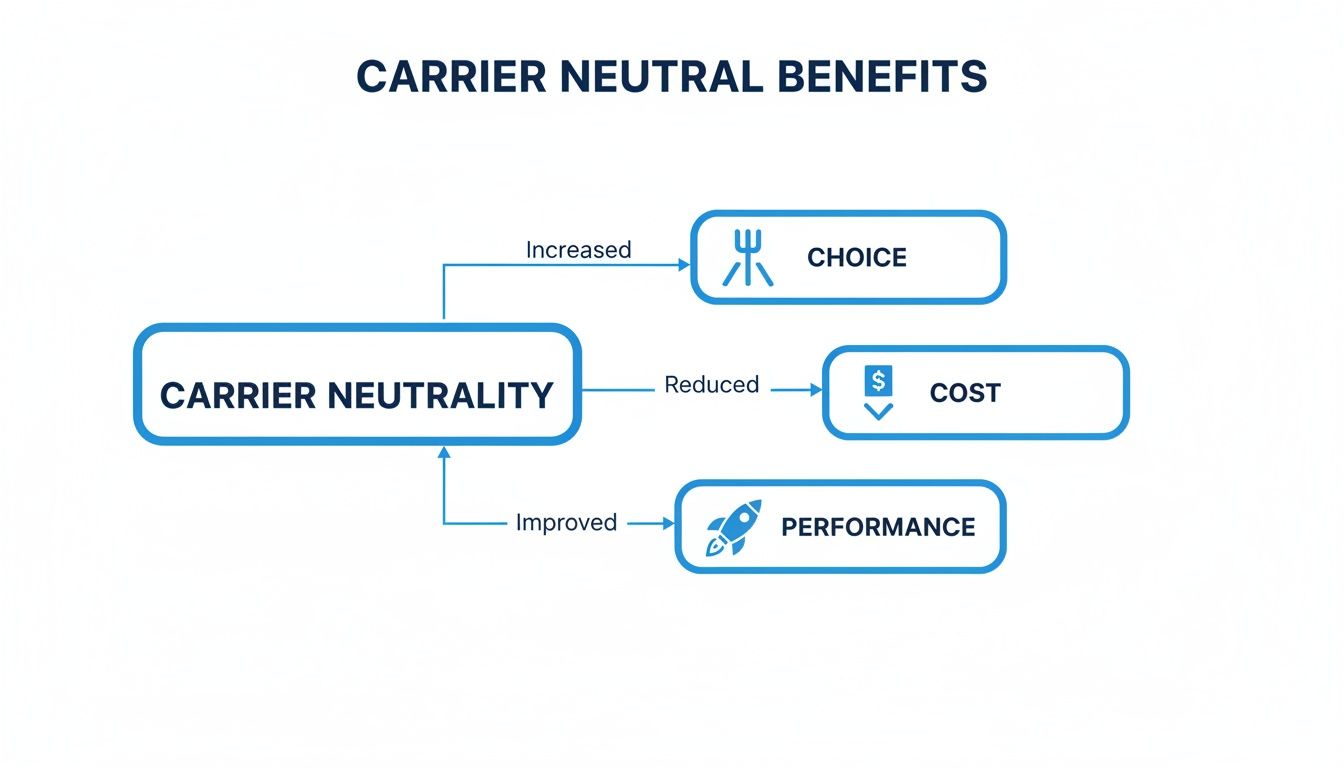
As you can see, a competitive environment with multiple providers not only drives down costs but also gives you the freedom to engineer the fastest possible network routes.
A Hub for Digital Business
This rich connectivity transforms the data center from a place where you just store equipment into a vibrant hub where digital business gets done. A standout feature of carrier-neutral facilities is their ability to support high-density interconnections, which is the key to crushing latency and boosting network performance.
The market is responding to this demand in a big way. North American data centers have more than 5,242 MW of capacity currently under construction for H1 2025. This expansion is fueling a colocation market expected to hit $204.41 billion by 2030, all driven by businesses needing agile, multi-cloud access. You can dig into more of the numbers in these North American data center trends on cbre.com.
For example, a financial services firm can get a serious competitive edge here. They can run a direct cross-connect to a trading platform's network inside the same facility, ensuring their automated trades execute with the absolute lowest latency possible—milliseconds matter.
At the very same time, that firm can connect to cloud providers for heavy-duty data analytics and link up with multiple network carriers to create resilient, redundant internet for their corporate offices. Being able to build a complete, interconnected hybrid IT strategy in one secure building is what really lets a business innovate and grow.
Putting Carrier Neutrality to Work Across Industries
The theory behind carrier-neutral data centers is great, but where the rubber really meets the road is in solving specific, real-world business problems. Different industries have their own unique connectivity headaches, and a carrier-neutral environment is like a versatile toolkit for fixing them. Whether it’s guaranteeing a flawless user experience or building bulletproof client services, the practical applications are everywhere.
Let's break down how three very different sectors use this model to get a serious leg up. Each example shows how the simple freedom to choose your network provider translates directly into better performance, stronger reliability, and healthier business outcomes.
SaaS Companies Delivering a Global Experience
For any Software-as-a-Service (SaaS) platform, user experience is king. Slow load times, jitter, or regional outages are the fastest way to lose customers. A SaaS provider simply has to deliver consistent, snappy performance to users all over the world—a challenge that’s next to impossible when you're locked into a single network.
Inside a carrier-neutral facility, a SaaS company can build a much more sophisticated, multi-homed network architecture.
- Here's a practical scenario: A project management software company hosts its core application in a carrier-neutral data center. To give their European customers the best possible speed, they connect directly with a major European ISP known for its strong regional presence. At the same time, they use a completely different Tier 1 provider that has the most direct network paths for their entire North American user base.
This strategy means user traffic always travels the shortest and most efficient route. It slashes latency, makes the application feel more responsive, and creates a seamless experience, no matter where a customer logs in from.
Online Gaming Platforms Eliminating Lag
In the high-stakes world of online gaming, latency is the ultimate fun-killer. A delay of just a few milliseconds—what gamers call "lag"—is often the difference between victory and defeat. For a game publisher, that means frustrated players and a tarnished reputation.
Gaming companies are in a constant battle to find the absolute lowest-latency connections to their players.
By setting up shop in a carrier-neutral facility, a gaming platform can strategically interconnect with the very same networks that major residential ISPs use to serve their players at home. This direct link dramatically shortens the path the game data has to travel, minimizing network "hops" and cutting latency down to the bare minimum.
Imagine a developer launching a new competitive shooter. They can look at where their players are concentrated and buy direct connections from the top three consumer ISPs in those key regions. This gets game data to players faster than their rivals can, creating that smooth, responsive gameplay that keeps people hooked.
Managed Service Providers Building Resilient Solutions
Managed Service Providers (MSPs) live and die by the reliability of the services they build for their clients. Proposing a one-size-fits-all network is a huge gamble; a single carrier outage could knock out services for dozens of their clients all at once.
Carrier neutrality is how MSPs build more valuable and resilient solutions. It allows them to offer clients a diverse menu of connectivity options, perfectly tailoring the network to fit each client's unique budget and uptime needs.
- Here is a practical example: An MSP that provides cloud backup services can give a client a primary connection on a premium, high-speed network for lightning-fast data transfers. But for true peace of mind, they can also configure a secondary, more budget-friendly connection from a different carrier as an automatic failover. That way, the client's data is always accessible, no matter what.
How to Choose the Right Colocation Partner
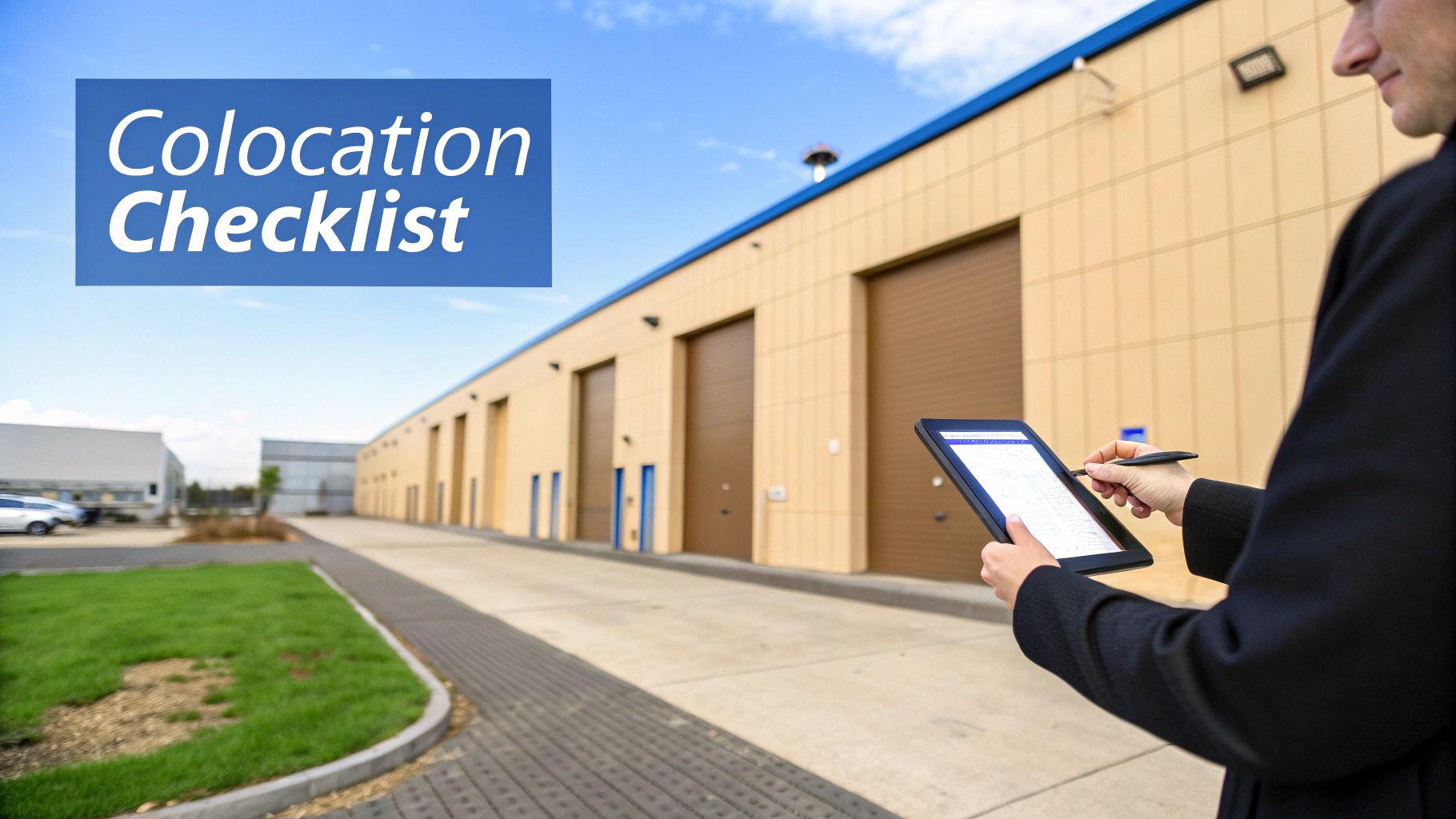
Choosing a colocation partner is a huge decision. It directly impacts your performance, security, and how easily you can grow down the road. The thing is, not all facilities are built the same, so you have to look beyond just the basics of space and power. A real partner gives you a solid foundation for growth, and that starts with asking the right questions before you sign anything.
This isn't just a simple vendor selection; it's about finding a provider who gets your technical needs today and can keep up with you for years to come. The whole process really begins by digging into the heart of what makes a carrier-neutral data center so valuable in the first place: its connectivity.
Network Density and Diversity
The whole point of going carrier-neutral is to have choices. So, your first job is to figure out just how much choice you actually have. Having a handful of carriers on-site is one thing, but a genuinely rich and diverse ecosystem is what lets you build a network that’s truly resilient.
Start by asking potential providers these critical questions:
- Carrier Count: How many unique network carriers are physically present in the facility and ready for cross-connects? The more carriers, the more competition, which almost always means better pricing for you.
- Fiber Entry Points: Does the building have multiple, physically separate entry points for its fiber? This is a huge deal. It protects you from a single point of failure, like a backhoe accidentally digging up the only fiber conduit into the building.
A deep network ecosystem is about more than just options—it's about creating a resilient, high-performance network that can withstand unforeseen disruptions and keep your services online.
Security and Reliability
Once you've confirmed the network is solid, it's time to shift your focus to the physical infrastructure that’s actually protecting your gear. The best facilities are absolutely obsessive about security and power reliability. They use multiple, overlapping layers of protection to make sure their uptime promises are more than just marketing fluff.
Look for these non-negotiable features:
- Physical Security: Make sure they have 24/7/365 on-site security staff, biometric access controls, and video surveillance covering every angle.
- Power Redundancy: Does the facility offer N+1 or, even better, 2N power redundancy? This is what ensures that a single failed power component doesn't take your equipment offline.
- Compliance Certifications: Don't be shy about asking for their certifications. Things like SOC 2 Type II, ISO 27001, and PCI DSS are independent proof that the provider meets high operational and security standards.
Scalability and Expert Support
Your infrastructure needs are going to grow—it's just a matter of when. A great partner makes scaling a smooth process, not a painful one. This is about more than just getting another rack; it’s about having access to expert support and other services that make your life easier.
The industry trend of leasing neutral capacity is a major driver here, giving businesses a scalable, future-proof path. With North American supply expected to hit a record 8,155 MW in the first half of 2025 and vacancies at a tiny 1.6%, the demand for these flexible, interconnected hubs is undeniable. For managed service providers needing rock-solid hosting, this dynamic is a huge advantage. You can learn more about how colocation costs are structured in our detailed guide.
Finally, make sure the provider offers essential services like 24/7/365 remote hands support for when you need someone on-site to push a button or swap a drive. Also, check for integrated options like DDoS mitigation or bare metal solutions that can work alongside your deployment.
Why Connectivity Choice Is a Strategic Advantage
In a world where your network is the backbone of your business, treating it like a mere utility is a mistake. It's a core asset, and the quality of that asset directly impacts your bottom line. This is where the real power of a carrier-neutral data center comes into play. It all boils down to one simple, game-changing idea: the power of choice.
This freedom isn't just a nice-to-have feature; it delivers tangible, measurable advantages in cost, performance, and resilience that a single-carrier facility can never offer.
Think of it this way: moving to a carrier-neutral facility is a strategic business decision, not just an IT one. You're investing in your company's agility. You gain the ability to adapt to sudden market shifts, scale operations on your own terms, and sidestep unnecessary risks. Building a network with multiple carriers is a fantastic way to guarantee uptime and performance, especially when you pair it with other critical services. For example, a well-designed network fortified with robust DDoS protection creates an infrastructure that's incredibly difficult to take down.
Ultimately, carrier neutrality lets you build the network your business needs, not the one a single provider sells. This strategic freedom empowers you to optimize operations, innovate faster, and unlock your organization's full potential in an increasingly competitive environment. Take a hard look at your current setup—is the power of choice working for you?
Got Questions? Let's Talk Details.
When you start digging into carrier-neutral data centers, a few common questions always seem to pop up. Let's clear the air on some of the most important ones so you can see exactly how this model works in the real world.
Carrier-Neutral Facility vs. Carrier Hotel: What's the Real Difference?
You’ll often hear these terms used as if they mean the same thing, but there’s a small, important distinction. Think of a carrier hotel as the Grand Central Station for network traffic in a major city. It's a specific type of carrier-neutral data center, but one that boasts an incredibly high concentration of network providers—often hundreds under one roof.
So, while every carrier hotel is by definition carrier-neutral, not every carrier-neutral facility has that super-dense network ecosystem required to be called a carrier hotel.
How Much Can I Really Save on Bandwidth?
This is where things get interesting. When you make carriers compete head-to-head for your business, prices naturally drop. While the exact amount you'll save depends on your location and requirements, it's common for businesses to see their bandwidth costs fall by 20% to 40% after making the switch.
It’s simple market dynamics: the more carriers there are in the building, the more leverage you have to negotiate a better deal.
Is Migrating My Gear a Massive Headache?
Moving your critical infrastructure can feel like a huge undertaking, but it's usually much smoother than people expect. A good provider makes the process feel almost turnkey. It really comes down to planning your rack layout, coordinating the logistics, and getting your hardware to the new site.
The secret weapon here is a service called "remote hands." This is where the data center's own expert technicians become an extension of your team. They can do everything from racking and stacking your servers to running cables, all under your direction. With a solid remote hands team, you can pull off a full migration without ever setting foot in the facility.
Ready to take control of your network and build a more resilient, cost-effective infrastructure? Soraxus offers top-tier colocation in strategically located carrier-neutral facilities, complete with 24/7 remote hands, full A+B power redundancy, and uncompromising physical security. See how we can help you scale your operations with confidence by visiting https://soraxus.com.