Unlocking Performance with 10Gbps Dedicated Servers

Soraxus Assistant
January 14, 2026 • 23 min read

So, what exactly is a 10Gbps dedicated server? In simple terms, it's a powerful physical server that's all yours, connected to the internet with a network pipe that can move data at an incredible 10 gigabits per second. This setup gives you raw, unshared power and speed, clearing up the digital traffic jams that can cripple demanding applications. All the server's resources—CPU, RAM, and that massive network connection—are for your use alone.
Understanding the Power of 10Gbps Dedicated Servers
Let’s think about it like a highway. A standard 1Gbps connection is like a single-lane road. It works fine for a bit of traffic, but during rush hour, it gets completely gridlocked. A 10Gbps connection, on the other hand, is a ten-lane superhighway built to handle a massive volume of traffic without breaking a sweat. For instance, a 1Gbps connection can download a 100GB file in about 14 minutes, while a 10Gbps connection handles the same task in under 90 seconds.
The "dedicated" part is equally critical. With shared hosting, you're fighting other users for resources and bandwidth. A dedicated server means that entire ten-lane highway is reserved just for you. This guarantees consistent, predictable performance, even when you're pushing it to its limits.
The Problem These Servers Solve
The biggest headache that 10Gbps dedicated servers solve is the network bottleneck. This is that digital traffic jam that happens when your application gets hit with more data requests than its connection can handle. For an e-commerce store on Black Friday, a streaming service dropping a hit show, or a popular multiplayer game server, a bottleneck means lag, buffering, and frustrated users—which often translates to lost revenue.
A 10Gbps uplink gives you the raw horsepower to blow right through those bottlenecks, ensuring a snappy, responsive experience for every single user. It lets your server juggle a huge number of things at once, from massive file downloads to complex database queries, all without slowing down.
By dedicating an entire high-capacity network port to one machine, you remove the single biggest point of failure for high-traffic applications: shared network congestion. This translates directly into better performance and a superior user experience.
This isn't just about being faster for the sake of it. It's about enabling operations that are simply impossible on slower connections. We're talking about delivering flawless 4K video streams, supporting thousands of concurrent SaaS users, or running massive data backups in a fraction of the time.
Core Advantages of a 10Gbps Port Speed
To put it all together, here’s a quick overview of the main benefits you gain by upgrading to a 10Gbps dedicated server.
| Benefit | Impact on Your Operations | Example Application |
|---|---|---|
| Massive Throughput | Handle enormous amounts of data transfer quickly and efficiently, reducing wait times for large files. | A video streaming platform serving 4K content to thousands of viewers simultaneously without buffering. |
| High Concurrency | Support thousands of simultaneous user connections without performance degradation or lag. | An online gaming server hosting a fast-paced multiplayer match with hundreds of active players. |
| Reduced Latency | Minimize delays in data transmission, creating a more responsive and real-time user experience. | A SaaS application that provides instant access to complex data and interactive dashboards for users. |
| Future-Proofing | Build infrastructure that can scale with user growth and increasing data demands without needing immediate upgrades. | An e-commerce site preparing for holiday traffic spikes or rapid business expansion. |
Each of these benefits directly impacts your ability to deliver a reliable, high-quality service, making the investment in a 10Gbps port a strategic move for any growing digital operation.
What a 10Gbps Uplink Actually Does for You

The number "10Gbps" sounds fast, but what does it really mean for your project? The true value isn't just a number on a spec sheet; it's about how that speed translates into tangible, real-world performance. To really get it, we need to look past the marketing and understand three core concepts: throughput, concurrency, and latency. These three pillars work together to define the experience your users have, especially when things get busy.
Think of your server’s network connection as a highway. Throughput is the number of lanes on that highway. A 10Gbps connection is a ten-lane superhighway compared to the single-lane country road of a 1Gbps port. It simply allows a much larger volume of data to move at any given moment, which is what you feel with lightning-fast downloads or smooth 4K video streams.
Handling Thousands of Users Without Breaking a Sweat
Next up is concurrency. This is about how many cars can use that highway at the same time without causing a traffic jam. A wider highway naturally supports more traffic. This is absolutely critical for any application that serves a lot of people at once.
Imagine a busy SaaS platform with thousands of users logged in, all pulling reports, updating records, and clicking around the interface. On a 1Gbps connection, that's a recipe for a bottleneck. Everyone's experience slows to a crawl. But a 10Gbps dedicated server handles those simultaneous requests effortlessly, keeping the experience snappy and responsive for every single user.
This same idea applies everywhere high traffic is a reality:
-
Online Gaming: A 10Gbps port can easily manage the constant stream of tiny data packets from thousands of players in a fast-paced game, keeping lag to a minimum.
-
E-commerce: During a flash sale, thousands of shoppers can hit your site at once to browse and buy without seeing that dreaded spinning wheel of death.
-
API Endpoints: A high-traffic API can serve millions of requests without becoming a chokepoint for all the apps that rely on it.
Wiping Out Congestion and Lag
Finally, we have latency—the time it takes for a packet of data to get from your server to the end-user. While physical distance plays a big role here, the biggest killer is often network congestion. When a 1Gbps connection gets pushed to its limit, data packets start lining up, waiting their turn to get sent. That queue is what creates lag, buffering, and slow page loads.
A 10Gbps port gives you so much breathing room that congestion simply stops being a problem for most applications. Data flows freely without getting stuck in a queue, which keeps latency consistently low even when your server is under heavy load. For real-time applications where every millisecond counts, this is a game-changer.
This relentless demand for more performance is visible across the industry. The global server market recently smashed records, hitting $95.2 billion in a single quarter, all driven by our exploding data needs. Projections show data center revenues climbing to $527.46 billion, with network infrastructure—the very foundation for 10Gbps ports—taking the lion's share at $254.80 billion. You can dig deeper into data center market trends to see how this investment is shaping the future of hosting.
In essence, a 10Gbps uplink doesn't just make things faster; it fundamentally changes what's possible. It empowers your server to handle workloads that would be unreliable or flat-out impossible on a standard connection.
Let’s put this into a practical, everyday scenario. Say you need to transfer a 500GB database backup to an off-site location for disaster recovery.
-
On a 1Gbps connection, under perfect conditions, you're looking at a wait time of roughly 1 hour and 10 minutes.
-
With a 10Gbps connection, that same transfer is done in just 7 minutes.
This isn't just about convenience; it's a massive strategic advantage. Shaving over an hour off critical tasks like backups or data migrations frees up your team, reduces risk, and makes your entire operation more efficient. For businesses that move terabytes of data every day, these time savings compound, turning what used to be day-long jobs into tasks that are finished in just a few hours.
When a 10Gbps Server Becomes Essential
Knowing the technical specs of a 10Gbps uplink is one thing, but knowing when to pull the trigger on that investment is another. It's the difference between a smart strategic move and a premature, costly expense. For many, a standard 1Gbps connection is plenty for day-to-day operations.
But for certain high-stakes workloads, a 10Gbps connection isn't just an upgrade—it's the bare minimum for survival.
The jump to a 10Gbps dedicated server becomes unavoidable when your application's success is directly tied to its ability to move huge amounts of data and serve thousands of people at once. This is the breaking point where a 1Gbps port starts to actively hurt your user experience, your efficiency, and ultimately, your bottom line.
Let's break down the exact scenarios where this kind of power becomes non-negotiable.
High-Traffic E-commerce and SaaS Platforms
For an e-commerce store or a SaaS platform, a traffic spike is a double-edged sword. A killer marketing campaign or a Black Friday rush can bring in a flood of customers, but if your server can't handle them, you're just turning away money. Sluggish page loads and apps that freeze under pressure are classic signs of a network bottleneck.
A 10Gbps server keeps your platform feeling snappy and responsive, even with thousands of users browsing, adding to their carts, or running complex queries. This massive bandwidth prevents the digital equivalent of a traffic jam, which is exactly what leads to abandoned carts and canceled subscriptions. You're not just buying speed; you're buying a smooth customer experience that keeps people engaged and clicking "buy."
Game Server Hosting
In online gaming, especially fast-paced shooters or massive MMOs, latency is everything. A few milliseconds of lag is the difference between victory and defeat, making a rock-solid connection an absolute must-have. A 1Gbps server might be fine for a small community, but it will choke under the strain of hundreds of concurrent players.
This is precisely where 10Gbps dedicated servers shine. They have the raw throughput to handle the constant, tiny data packets from every single player in real-time. For example, a popular multiplayer game might send 60 packets per second for each player. With 500 players, that's 30,000 packets per second—a load a 1Gbps connection struggles with, but a 10Gbps server handles with ease, ensuring a fluid, lag-free experience that builds a loyal community.
For mission-critical applications like competitive gaming or high-volume e-commerce, a 10Gbps uplink is an investment in reliability. It guarantees that your service remains stable and performant during the most crucial moments of user activity.
The industry is clearly betting on this need for speed. To keep up with demanding workloads like streaming and AI, providers are rapidly expanding to over 50 worldwide data centers, all equipped with 10Gbps network ports. This growth is backed by serious money, with the server market hitting $95.2 billion in just the first quarter and data centers valued at $527.46 billion. Reading up on these strategic expansions and market milestones really puts the scale of this investment into perspective.
Content Delivery and Video Streaming
Is your business built on distributing large files? Think high-res video, software downloads, or massive datasets. If so, a 10Gbps server isn't a luxury; it's a foundational requirement. Trying to serve 4K video streams to thousands of viewers on a lesser connection is a recipe for endless buffering and angry emails.
A 10Gbps server is the perfect engine for a Content Delivery Network (CDN) origin or a high-performance streaming server. It can push out enormous amounts of data without even breaking a sweat, ensuring everyone gets a crisp, uninterrupted experience. This is critical for:
-
Video on Demand (VoD) platforms with huge media libraries.
-
Live streaming services for events, webinars, or gaming.
-
Software distribution portals that need to deliver large installers quickly.
-
E-learning platforms hosting high-definition video courses.
Big Data and Disaster Recovery
When you're dealing with big data, backups, and disaster recovery, time is quite literally money. Shuttling terabytes of data between locations for off-site backups or analysis on a 1Gbps link is painfully slow. A job that should take minutes can drag on for hours, creating risk and killing your team's agility.
With a 10Gbps uplink, these workflows are completely transformed. A multi-terabyte backup that might have previously taken all day can be done in just a couple of hours. This speed enables more frequent backups, lightning-fast disaster recovery, and seamless data synchronization between global sites. When data is your most valuable asset, that kind of efficiency is a massive strategic advantage.
Choosing Your Network Speed: 1Gbps vs. 10Gbps vs. 100Gbps
When you step into the world of dedicated servers, one of the first big decisions you'll face is network speed. This choice isn't just a technical detail; it directly hits your application's performance and your monthly budget. Picking the right port speed—whether it's 1Gbps, 10Gbps, or even 100Gbps—is all about matching the hardware to your actual workload, not just grabbing the biggest number you can find.
Think of it like choosing the right tool for a job. You wouldn't use a sledgehammer to hang a picture, and you wouldn't try to break up concrete with a tiny tack hammer. Each network speed is built for a different scale of work, and making the right investment from the start saves a lot of headaches down the road.
The chart below gives you a quick visual on the kinds of demanding workloads where a 10Gbps connection really starts to shine.
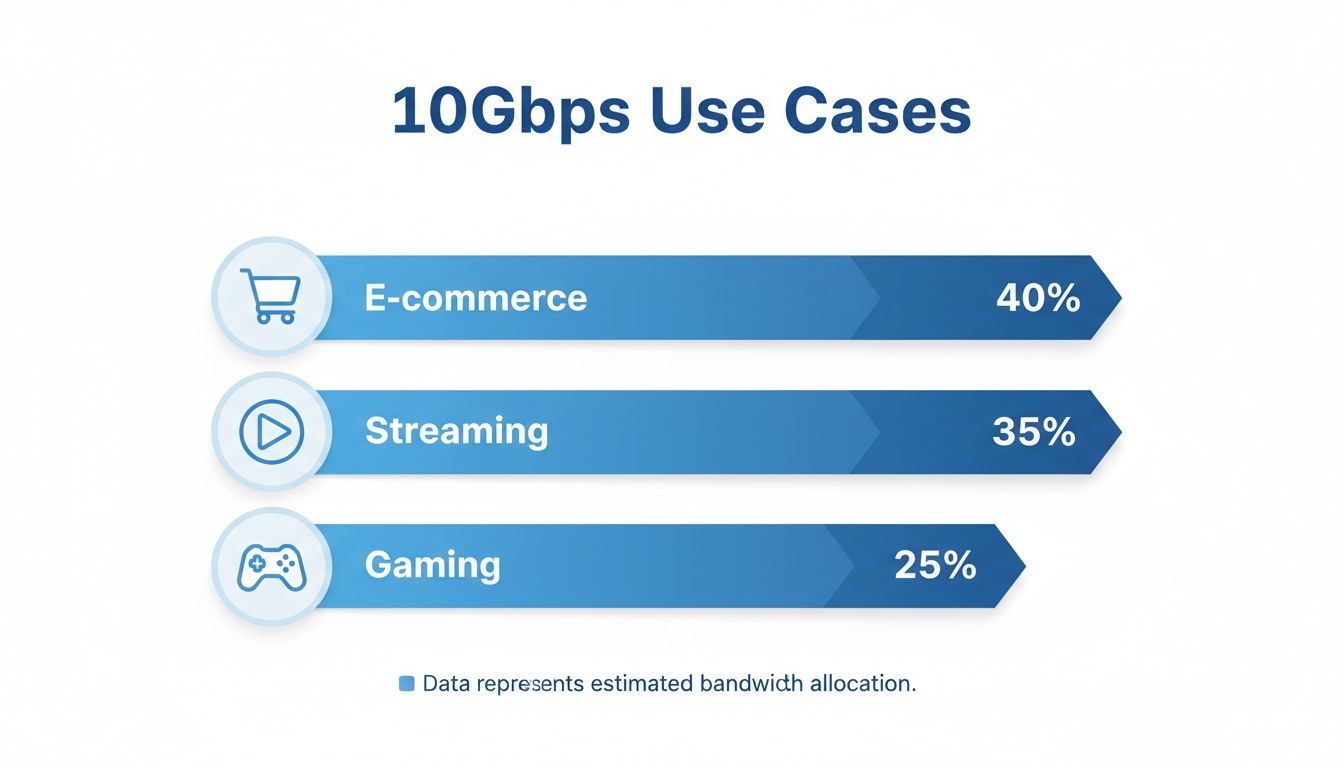
As you can see, things like e-commerce, HD streaming, and online gaming are prime candidates that get a massive boost from the raw throughput a 10Gbps port delivers.
The Standard Workhorse: 1Gbps
A 1Gbps (1 Gigabit per second) connection has been the industry standard for years, and for good reason. It’s the trusty workhorse that provides plenty of bandwidth for a huge range of applications—from small business websites and company blogs to staging environments and apps with moderate traffic. It’s reliable, cost-effective, and gets the job done without a fuss.
But every workhorse has its limits. As your user base grows or your data needs climb, you can start bumping your head against that 1Gbps ceiling. That bottleneck means slower page loads, laggy apps, and a frustrating user experience during traffic spikes—all clear signs that it’s time for an upgrade.
The High-Performance Sweet Spot: 10Gbps
This is where 10Gbps dedicated servers come in. Offering a full ten times the throughput of a 1Gbps port, a 10Gbps connection hits the perfect sweet spot for growing businesses and data-intensive operations. It gives you the muscle to handle serious traffic and demanding workloads without jumping to the enterprise-level costs of a 100Gbps line.
This is the go-to choice for:
-
High-traffic e-commerce sites bracing for major sales events.
-
SaaS platforms serving thousands of users at the same time.
-
Game servers hosting fast-paced, competitive multiplayer matches.
-
Video streaming services delivering crisp, high-definition content.
-
Large-scale data backup and disaster recovery tasks that need to move fast.
A 10Gbps server delivers the best balance of performance, scalability, and cost for the vast majority of high-demand applications. It’s a massive leap from 1Gbps that effectively future-proofs your infrastructure against surprise traffic surges and organic growth.
The Hyperscale Behemoth: 100Gbps
Finally, we have the 100Gbps connection. Frankly, this is in another league entirely and is reserved for very specific, massive-scale use cases. We're talking about the infrastructure that powers the internet itself—major backbone providers, hyperscale data centers, and global cloud platforms moving petabytes of data between facilities.
For most businesses, even those with incredibly heavy traffic, a 100Gbps port is simply overkill. The cost is astronomical, and it's rare for a single application server to generate enough traffic to even scratch the surface of that capacity. It’s a solution for building infrastructure, not for running a typical application.
To put it all into perspective, here's a side-by-side look at how these three network speeds stack up against each other.
Comparing Network Port Speeds
Here's a side-by-side look at 1Gbps, 10Gbps, and 100Gbps connections to help you match the right speed to your workload.
| Specification | 1Gbps Port | 10Gbps Port | 100Gbps Port |
|---|---|---|---|
| Max Throughput | ~125 MB/s | ~1,250 MB/s | ~12,500 MB/s |
| Ideal Workloads | Websites, small apps, moderate traffic, backups. | High-traffic e-commerce, SaaS, gaming, streaming. | Data centers, internet exchanges, cloud backbones. |
| Typical Cost | Standard / Entry-Level | Premium / High-Performance | Enterprise / Hyperscale |
| Primary User | Small to medium businesses. | Growing businesses, demanding applications. | Major service providers and corporations. |
By analyzing your current traffic, thinking about where you’ll be in a year, and truly understanding what your application needs, you can choose the right network speed with confidence. For most businesses hitting a growth spurt, a 10Gbps dedicated server is the perfect blend of power, value, and future-proofing.
Building a Complete High-Performance Server
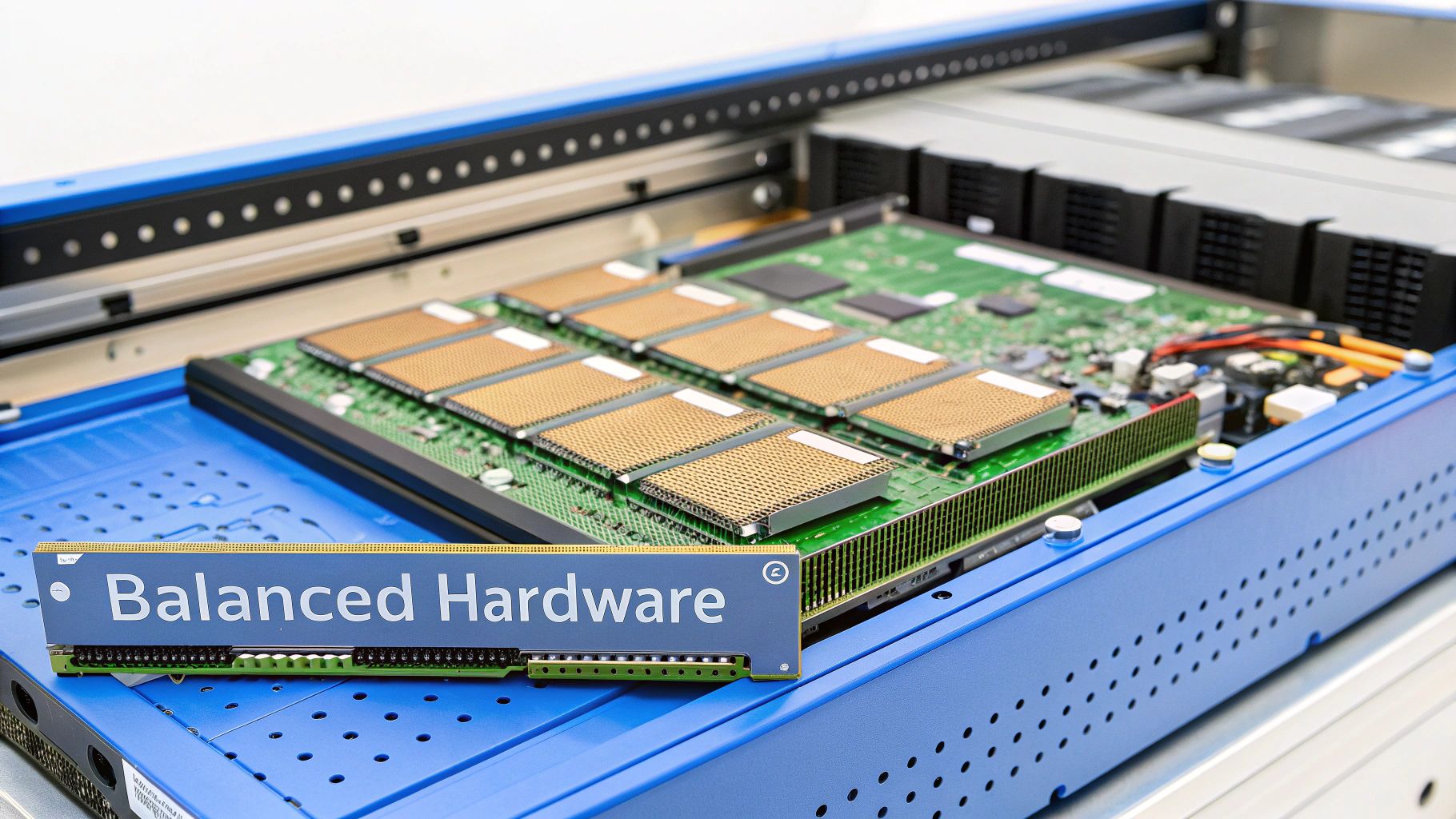
Getting a 10Gbps dedicated server is a huge win, but it's important to remember that the network port is just one piece of a much larger performance puzzle. To really see what that connection can do, every other component has to be able to keep up.
Think of it like dropping a V8 engine into a car that still has bicycle tires. All that raw power is useless without the right supporting parts. A fast port on a slow, congested network is a wasted investment—you'll never hit the speeds you're paying for.
Matching Hardware to Your Network Speed
The biggest mistake you can make is creating an internal bottleneck. A 10Gbps connection can push and pull data so fast that it will overwhelm older or underpowered hardware. The entire system, from the processor to the storage drives, needs to be built for speed.
Here are the non-negotiables for a balanced build:
-
Powerful CPUs: You need modern, multi-core processors from leading manufacturers. These are the workhorses that juggle thousands of simultaneous connections and execute your application’s logic without breaking a sweat.
-
Plenty of RAM: Ample memory is crucial. It lets the server cache massive datasets and keep frequently used information instantly accessible, preventing slowdowns from having to fetch data from slower disk storage.
-
Ultra-Fast NVMe SSDs: For storage, NVMe (Non-Volatile Memory Express) solid-state drives are the only real choice. Their read/write speeds are phenomenal and can actually keep pace with a 10Gbps network, which is absolutely critical for databases, file hosting, or any I/O-heavy workload.
Pairing a blazing-fast connection with outdated hardware is the most common reason people get disappointing results.
Beyond the Server Itself
The environment your server lives in is just as important as what’s inside it. This means looking at the data center's physical security, the network's resilience, and the tools you have for remote management when things inevitably go sideways.
High on that list is network protection. A powerful server with a fat pipe is a very tempting target for distributed denial-of-service (DDoS) attacks. These floods of malicious traffic can easily saturate even a 10Gbps port, knocking your services offline in an instant.
An unprotected 10Gbps port is an open invitation for disruption. Always-on, automated DDoS protection isn't an optional add-on; it's a fundamental requirement for maintaining uptime in a high-performance environment.
A solid DDoS mitigation system filters out junk traffic before it ever hits your server, so your real users never notice a thing. We break down the different layers of defense in our guide on dedicated servers with DDoS protection.
Finally, don't overlook out-of-band management tools like IPMI or KVM. These give you direct, BIOS-level access to your server, completely separate from its main network connection or operating system. If a bad config file takes your server offline, you can use IPMI to reboot it, reinstall the OS, or fix the problem as if you were standing right in front of the machine. This level of control is indispensable for any mission-critical 10Gbps dedicated server.
How to Select the Right 10Gbps Server Provider
Picking the right provider for your 10Gbps dedicated servers is every bit as critical as choosing the right hardware. After all, a beast of a server on a flimsy network is just a wasted investment. Think of this as a practical checklist to help you find a hosting partner who can actually deliver on their promises.
First up, you need to dig into their network quality. Don't just settle for marketing hype; look for real evidence of a resilient, multi-homed network. A serious provider will be transparent about their carrier blend, openly talking about which Tier-1 backbones they use and their peering arrangements.
Why does this matter? A diverse blend of top-tier carriers means your data has multiple high-speed routes to get anywhere in the world, which is key to keeping latency low and avoiding bottlenecks.
Evaluating Support and Billing Models
When you're dealing with high-performance infrastructure, expert technical support isn't a "nice-to-have"—it's a necessity. If something goes wrong, you need to be talking to a real engineer who can solve complex problems, not someone just reading from a script. Look for providers that offer 24/7/365 support and can back it up with impressive response times, ideally under 15-20 minutes.
Next, let's talk about money. You have to get a firm grasp on how you'll be billed for that massive 10Gbps pipe, because different models can drastically change your monthly bill.
-
Unmetered Billing: This is the simplest model. You pay a flat monthly rate for your 10Gbps port and can push as much data as you want without worrying about overage fees. It's perfect for predictable, heavy-hitting traffic like video streaming or large file distribution.
-
95th Percentile Billing: This model is a bit more nuanced. The provider monitors your bandwidth usage all month, lops off the top 5% (your biggest traffic spikes), and then bills you based on the next highest peak. If your traffic is more bursty than constant, this can be a much more cost-effective option.
Getting your head around these models is the key to forecasting your costs and dodging nasty surprise invoices. To see how these factors play into the final cost, you can explore a detailed breakdown of dedicated servers prices for more context.
Location and Customization Options
Finally, don't overlook the physical side of things. The data center's location has a direct and immediate impact on latency for your users. If your audience is primarily in North America, a server in a central US location will feel incredibly snappy compared to one hosted across the ocean in Europe.
A provider's willingness to offer custom hardware configurations is a huge green flag. It shows they have deep expertise. Standard, one-size-fits-all servers rarely work for specialized workloads, so the ability to hand-pick the CPU, RAM, and storage is crucial.
Your project is unique, and your provider should be able to build a machine that perfectly reflects that. This flexibility means you're not paying for hardware you don't need or, worse, creating performance bottlenecks with underpowered components. A provider that offers both ready-to-go and fully custom builds gives you the power to architect the exact solution you need.
Frequently Asked Questions
Jumping into the world of high-performance hosting naturally brings up a few questions. Let's tackle some of the most common ones about 10Gbps dedicated servers to clear up any lingering doubts you might have.
When Is a 10Gbps Server Overkill?
Honestly, a 10Gbps server is overkill when your application simply doesn't produce enough traffic to justify the horsepower. For a standard business website, a personal blog, or an internal app with a few hundred users a day, a 1Gbps connection is plenty—and much friendlier to your budget.
You should only start thinking about 10Gbps when your current 1Gbps pipe is consistently maxed out. You'll see this as slow load times, endless video buffering, or lag in your application during peak hours. A good rule of thumb: if your network usage graphs are regularly hitting 80-90% of your 1Gbps capacity, that's a tell-tale sign you're outgrowing your connection and need more room to breathe.
What Does "Unmetered 10Gbps Bandwidth" Actually Mean?
Think of it like an all-you-can-eat buffet for data. "Unmetered" means you pay a flat monthly fee for your 10Gbps port, and the provider doesn't bill you for how much data you push through it. You can run your connection at full tilt, 24/7, without getting slapped with surprise overage charges.
This is a game-changer for businesses with heavy, but predictable, data needs. Imagine a video streaming service pushing HD content to thousands of viewers. An unmetered plan gives them total budget predictability, even if a video goes viral overnight. It’s important to note this isn't the same as "unlimited," which can sometimes come with sneaky speed throttling or vague "fair use" clauses.
Unmetered billing gives you cost certainty. It lets you go all-in on demanding tasks like large-scale file distribution or real-time data replication without worrying about the bill at the end of the month.
Of course, moving that much data means security is paramount. It's a good time to brush up on network security best practices to make sure that firehose of a connection stays locked down.
Do I Need Special Software for a 10Gbps Server?
Nope, not from the client side. Your server’s operating system (like Linux or Windows) and its network card are built to handle the connection right out of the box.
The real work is on the server-side applications. Your web server software (like Nginx or Apache) and databases need to be tuned to handle the sheer volume of concurrent connections a 10Gbps pipe can throw at them. A well-optimized software stack is what truly unlocks the potential of the underlying hardware.
Can My Hardware Keep Up with a 10Gbps Port?
That’s the million-dollar question, and the answer comes down to balance. To actually use all 10Gbps of network speed, the rest of your server components need to be able to keep pace.
A slow, spinning hard drive, a weak CPU, or not enough RAM will create internal bottlenecks that choke your performance long before the network does. For instance, if your storage drives can only write data at 1Gbps, you'll never be able to use your full network speed for disk-heavy jobs like large backups. That’s why servers built for 10Gbps workloads are typically packed with high-core CPUs and blazing-fast NVMe SSDs—the whole system is designed to handle the flow.
Ready to unleash the full power of your high-demand applications? With Soraxus, you can get your hands on powerful 10Gbps dedicated servers rocking the latest Intel and AMD CPUs, enterprise-grade NVMe storage, and backed by always-on DDoS mitigation. Get the raw performance and reliability your project deserves by visiting https://soraxus.com to configure your server today.