What Is a Colocation Data Center: A Complete Guide to Benefits and Services

Soraxus Assistant
January 13, 2026 • 27 min read
Ever wondered how companies keep their websites and applications running 24/7 without building a multi-million dollar server facility in their own office? The answer for many is a colocation data center.
Think of it like a high-tech, ultra-secure apartment building for your company's most critical hardware. You rent a private, secure space for your servers and networking gear, and the facility provides all the heavy-duty essentials—industrial-strength power, cooling, and internet connectivity. It's the perfect middle ground, giving you the power of an enterprise-grade data center without the astronomical price tag of building one from scratch.
Understanding the Colocation Data Center Model
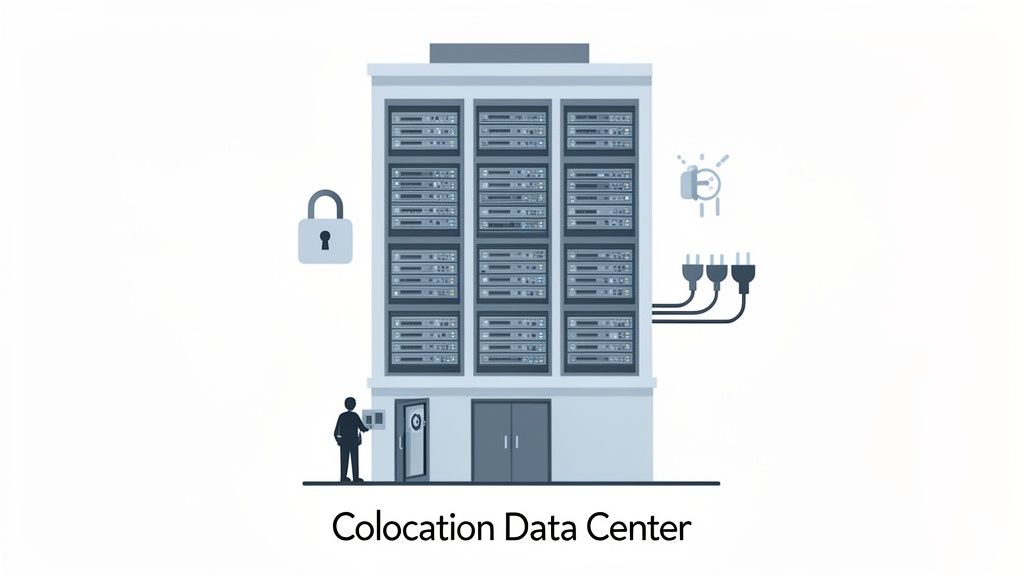
Instead of cramming servers into a dusty office closet (we’ve all seen it), colocation allows you to move your hardware into a facility engineered for one thing: keeping technology online, cool, and safe. This means you get to offload the headache of managing things like redundant power grids, complex climate control systems, and round-the-clock physical security to a team of specialists. For example, a growing e-commerce business can place its web and database servers in a colocation facility to ensure its online store never goes down during a local power outage, protecting sales and customer trust.
The best part? Your team keeps complete control over what matters most—your servers, your software, and your data. You manage the operating systems and applications that drive your business, while the colocation provider ensures the physical environment is rock-solid and always available. This shared responsibility is what makes colocation so appealing.
A Clear Division of Labor
The real magic of colocation is the clear line it draws in the sand. Your IT team can stop worrying about a power outage or an HVAC failure over a holiday weekend and instead focus on projects that actually grow the business.
This isn't a niche solution, either. The global data center colocation market was valued at USD 31,921.74 million in 2020 and is projected to explode to an incredible USD 331,999.03 million by 2035. That kind of growth shows just how many businesses are realizing the need for reliable, scalable infrastructure.
To make this crystal clear, here’s a quick breakdown of who handles what in a typical colocation partnership.
Colocation Responsibility Breakdown: Provider vs. Customer
| Component or Service | Provider Responsibility | Customer Responsibility |
|---|---|---|
| Physical Building | Facility maintenance, security, and access control. | None. |
| Power Infrastructure | Redundant power feeds, UPS systems, and backup generators. | Powering individual servers and equipment. |
| Environmental Control | Advanced cooling, humidity, and fire suppression systems. | Ensuring hardware is properly racked and cabled. |
| Servers & Storage | None. | Owning, installing, and managing all hardware. |
| Software & Data | None. | Installing OS, applications, and managing all data. |
As you can see, the provider takes care of the physical world so you can own the digital one.
By outsourcing the physical layer, your business gains access to infrastructure that would be prohibitively expensive to build and maintain independently. It’s a strategic move to achieve enterprise-level resilience on an operational budget.
This model is a game-changer for businesses that can't afford any downtime, like SaaS platforms, online gaming communities, and managed service providers. Exploring colocation services is the first step toward building a foundation for truly scalable and secure operations.
What's Inside a Colocation Data Center? The 5 Core Components
A colocation facility isn't just a secure room with some server racks. It's a highly sophisticated, purpose-built fortress for your hardware, engineered from the ground up to deliver rock-solid stability and performance. These facilities are built on five foundational pillars that work together to create an environment that’s nearly impossible for most businesses to replicate on their own without a massive investment.
When you understand these five core components, you start to see the real value you’re getting. Each one is designed to eliminate a critical point of failure—from a city-wide power outage right down to the microscopic dust particles that can choke sensitive electronics. Let’s break them down.
Uninterruptible Power Redundancy
The most basic promise of any data center is simple: keep the lights on. Always. In your office, a quick power flicker is just an annoyance. In a data center, it's a disaster. To guarantee uptime, colocation facilities build in multiple layers of power redundancy.
It all starts with diverse power feeds, which means the facility is hooked up to at least two independent utility substations. If a construction crew accidentally cuts a line feeding one grid, the data center instantly and seamlessly switches to the alternate feed. Your servers never even notice.
But what happens if the entire city grid goes down? That’s where the next layers kick in:
- Uninterruptible Power Supply (UPS) Systems: Think of these as giant, instant-on battery backups. The moment utility power fails, the UPS systems take over, providing perfectly clean electricity to bridge the critical few seconds it takes for the heavy-duty generators to spin up.
- On-Site Diesel Generators: For longer outages, these industrial-grade generators can power the entire facility for days on end, thanks to massive on-site fuel reserves. They're regularly tested under load to make sure they're ready to go at a moment's notice.
A real-world example? A financial services company hosting its trading platform. For them, a single second of downtime during market hours could mean millions in lost revenue. The A+B power design in a colocation facility ensures their platform stays online and processing transactions, even if the rest of the city block goes dark.
Advanced Climate Control and Cooling
Modern servers, especially high-performance ones, pump out a staggering amount of heat. Your standard office AC unit would be completely overwhelmed by the thermal load of hundreds of servers running at full tilt. When servers get too hot, they automatically slow down to protect themselves (throttling), and eventually, the heat will cause permanent damage.
Colocation data centers use highly specialized cooling systems designed to maintain a precise and stable environment. They don't just control the temperature; they meticulously manage humidity and air purity as well.
A stable thermal environment is non-negotiable for hardware longevity. Colocation providers use sophisticated techniques like hot/cold aisle containment, which separates the hot exhaust air from servers from the cold intake air, drastically improving cooling efficiency and reducing energy consumption.
This is absolutely essential for a SaaS company running CPU-intensive analytics. Their servers can run at peak performance 24/7/365 without ever risking thermal throttling that would slow down customer queries. This controlled environment is also a huge deal for companies managing large fleets of bare metal servers, as it directly extends the lifespan and reliability of their physical investment.
Blazing-Fast and Resilient Connectivity
Your hardware is only as good as its connection to the rest of the world. An office building might have one or two internet providers, which creates a single point of failure. A carrier-neutral colocation data center, on the other hand, is a major intersection on the internet highway.
These facilities are network hubs, giving you direct access to a whole ecosystem of dozens of regional, national, and global network carriers all in one building. This gives you the freedom to pick and choose the providers that offer the best performance, pricing, and routes for your specific needs.
This "meet-me room" setup gives you two powerful advantages:
- Choice and Competition: You can easily shop around for the best rates and performance from different carriers, preventing vendor lock-in.
- Redundancy and Resilience: You can connect to multiple carriers at the same time. If one network has an outage or starts performing poorly, your traffic can be automatically rerouted through another provider, keeping your services online for your users.
Imagine an online gaming company that needs the lowest possible latency for players across North America. Inside a carrier-neutral facility, they can plug directly into multiple Tier 1 networks, fine-tuning their traffic paths to slash lag and deliver a buttery-smooth gaming experience.
Multi-Layered Physical Security
Protecting your digital assets always starts with securing the physical hardware they live on. Colocation data centers take this seriously, implementing strict, multi-layered security protocols that feel more like a military base than an office building.
Access is tightly controlled through a series of checkpoints that filter out anyone who doesn't belong:
- Perimeter Security: It starts with fencing, vehicle barriers, and constant 24/7 exterior camera surveillance.
- On-Site Staff: Security guards are on-site around the clock, actively monitoring the facility and ready to respond to any incidents.
- Access Control: Getting inside requires passing through multiple secure doors, often with a combination of key cards, PIN codes, and biometric scanners (like fingerprint or iris readers).
- Mantraps: These are small, two-door security rooms. To get through, the first door has to close and lock behind you before the second door will open, making it impossible for someone to "tailgate" their way in.
- Video Surveillance: Hundreds of cameras cover every aisle and entry point, with all footage archived for security audits.
For a healthcare organization storing sensitive patient data, this level of physical security is non-negotiable for meeting compliance standards like HIPAA. It provides an ironclad guarantee that only fully-vetted, authorized personnel can ever get near their servers.
Expert Remote Hands Support
It’s 3 AM on a Saturday. A server has locked up and needs a hard reboot, but your team is hundreds of miles away. What do you do? This is where Remote Hands support becomes an absolute lifesaver.
Remote Hands is a service where the data center's on-site technicians act as your eyes and hands inside the facility. You simply open a ticket, and a trained professional will perform routine tasks for you, like:
- Power cycling a frozen server.
- Plugging in a console cable so you can run remote diagnostics.
- Swapping out a failed hard drive or RAM stick.
- Verifying that a network cable is properly seated.
For any business that doesn't have its own staff near the data center, this service is invaluable. For example, a web hosting company based in another state can use remote hands to have a technician replace a faulty power supply in one of their servers, avoiding a costly flight and resolving the issue within minutes instead of hours. It saves you the enormous cost and delay of sending an engineer to the facility just to handle a five-minute task, ensuring that small physical issues get resolved immediately, any time of day or night.
Colocation vs. On-Premise vs. Cloud Hosting
Figuring out where your IT infrastructure should live is one of the biggest calls a tech leader can make. This decision ripples through everything—your budget, application performance, ability to grow, and how much control you have. The three main paths are colocation, building it yourself (on-premise), or renting it from a hyperscaler (cloud hosting), and each comes with its own set of very real trade-offs.
An on-premise data center gives you the keys to the kingdom—total control. But that control comes with a staggering price tag. You're on the hook for absolutely everything: from pouring the concrete and wiring the power to installing cooling systems, hiring security guards, and staffing a 24/7 team.
On the flip side, the public cloud offers amazing flexibility. You can spin up resources in minutes and scale on a dime. The catch? You give up control over the physical hardware, and you can get blindsided by unpredictable monthly bills and performance hiccups.
This is where colocation finds its sweet spot. It offers the best of both worlds: the raw power and predictable performance of owning your hardware, but without the crippling capital expense and operational headache of running the building yourself.
A Head-to-Head Comparison
To land on the right choice, you need a clear, honest look at how these models stack up. The decision usually comes down to a classic battle: upfront capital expenses (CapEx) versus ongoing operational expenses (OpEx). But it’s also about what you truly need—is it ironclad control, top-tier security, or guaranteed performance? A financial services firm might obsess over the physical security colocation provides, while a brand-new startup with spiky traffic might lean into the cloud's elasticity.
This flowchart breaks down how a proper colocation facility shields your gear from the most common real-world threats—power outages, overheating, and break-ins. These are the exact risks that are incredibly difficult and expensive to truly solve when you’re just running a server room in the back of your office.
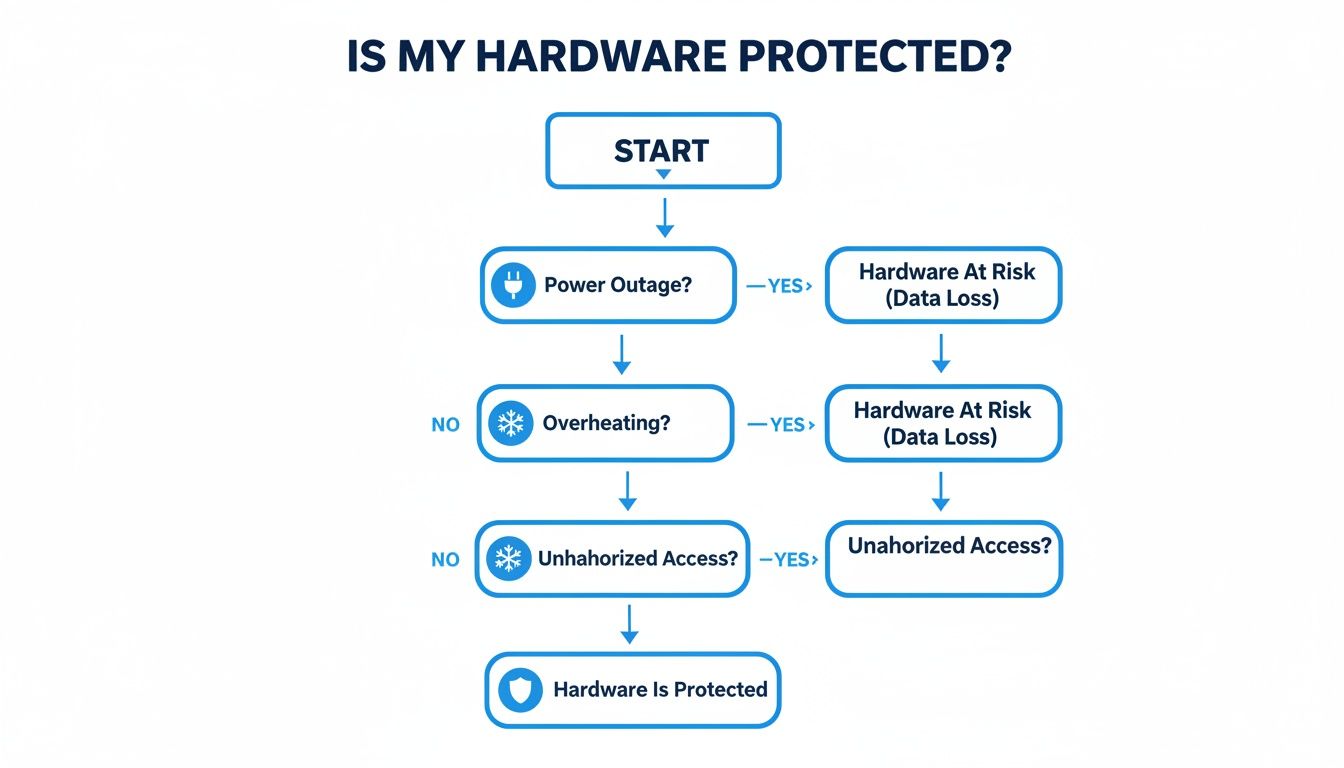
As you can see, it's all about layers of redundancy and security. These systems are designed from the ground up to make sure your critical hardware stays online, cool, and safe. Now, let’s get into the specifics with a direct comparison.
Infrastructure Model Showdown
| Feature | On-Premise Data Center | Colocation Data Center | Public Cloud Hosting |
|---|---|---|---|
| Initial Cost | Very High (CapEx): A massive upfront investment in building, power grids, and industrial cooling. | Low (OpEx): You buy your servers, but the facility costs become a predictable monthly bill. | Very Low (OpEx): Zero upfront hardware costs. You pay as you go for the resources you use. |
| Control Level | Total Control: You own and manage every single wire, server, and access badge. | High Control: You own and manage your servers and software. The provider handles the facility. | Low Control: You manage your virtual machines but have zero access to the physical hardware they run on. |
| Scalability | Difficult & Slow: Adding more capacity is a major construction project requiring huge investment and time. | Moderate & Planned: You can easily add more racks or cabinets as needed with some planning. | Instant & Elastic: Scale resources up or down on-demand, anytime, in a matter of minutes. |
| Performance | Predictable: Your hardware is dedicated to your workloads, guaranteeing consistent performance. | Predictable: Dedicated hardware means no "noisy neighbors" stealing your resources. Performance is rock-solid. | Variable: Performance can be inconsistent due to other tenants on the same physical server (the "noisy neighbor" effect). |
| Security | Your Responsibility: You are 100% responsible for everything from door locks to firewalls. | Shared Responsibility: The provider secures the building; you secure your own servers and network. | Shared Responsibility: The cloud provider secures the infrastructure; you secure your apps and data. |
| Maintenance | Your Responsibility: You have to hire and manage a 24/7 team to maintain the entire facility. | Provider's Responsibility: The provider handles all facility upkeep, from testing generators to servicing chillers. | Provider's Responsibility: The cloud provider manages all hardware and infrastructure maintenance behind the scenes. |
The key takeaway is that there's no single "best" choice—only the right fit for a specific job. Colocation is the clear winner for businesses that need the performance and control of their own hardware but want to completely offload the immense cost and complexity of running a world-class data center.
Making the Right Choice for Your Business
So, how do you decide? It all comes down to a careful look at what your business actually needs.
- An on-premise build might still be the only option for a massive global bank with highly specific security protocols and the deep pockets to fund a private facility.
- The public cloud is a fantastic playground for new apps with unpredictable traffic, dev/test environments, and companies that value speed and agility above all else.
- Colocation is tailor-made for established businesses running mission-critical applications. Think e-commerce sites that can’t afford downtime, SaaS platforms that need reliable performance, or online gaming companies where low latency is everything. These workloads demand the stable, high-speed performance of dedicated hardware, backed by the enterprise-grade power, cooling, and security you can only get from a specialized facility.
Who Actually Uses Colocation?
So, we’ve covered the "what" and "how" of colocation data centers. But the real story is in the "who"—which businesses are actually staking their entire operation on this model? It turns out it's a surprisingly diverse crowd, from global corporations to nimble startups. Each one turns to colocation to solve very specific, high-stakes problems with performance, security, and uptime.
These aren’t just abstract IT strategies; they're practical moves for businesses where even a minute of downtime can be catastrophic. Colocation gives them access to an infrastructure powerhouse that would be incredibly expensive and complicated to build themselves.
The Enterprise Powerhouse
For a large enterprise, business continuity isn't just a goal; it's the foundation of their existence. Picture a multinational bank processing thousands of transactions a second. Their core databases simply cannot go down. This is the classic colocation use case.
The bank will set up its primary production environment in a top-tier colocation facility, taking full advantage of the N+1 power and robust physical security. But they won't stop there. For a bulletproof disaster recovery plan, they’ll mirror that entire setup in a second facility in a different geographic region. If a hurricane or massive power grid failure hits the first site, they can failover to the second one almost instantly. For their customers, it’s business as usual.
The Always-On SaaS Platform
Think about a fast-growing Software-as-a-Service (SaaS) company—maybe one that provides a project management tool to thousands of businesses. Their customers live and breathe on that platform, and they expect it to be available 24/7/365. Any hiccup doesn't just annoy users; it actively costs them money and erodes trust in the SaaS brand.
This is where colocation becomes the bedrock of their promise. They deploy their servers in a facility that offers not just guaranteed uptime but also sophisticated DDoS protection. The moment a cyberattack tries to flood their service with junk traffic, the data center’s mitigation systems kick in, scrubbing the attack traffic before it ever reaches their servers. Legitimate users never notice a thing, and the platform stays online and fast, even under fire.
For businesses whose revenue is directly tied to application availability, colocation isn't just an IT choice—it's a core business strategy. It provides the stable, secure, and protected foundation needed to build customer trust and scale confidently.
The Competitive Gaming Community
In the hyper-competitive world of online gaming, latency is the ultimate fun-killer. A delay of just a few milliseconds is the difference between a victory and a frustrating loss. A gaming company hosting its own servers has to deliver a silky-smooth, lag-free experience, or its players will simply go somewhere else.
This is a problem colocation was born to solve. By placing their high-performance servers in a carrier-neutral data center, the gaming provider can plug directly into a rich ecosystem of Tier 1 internet backbones. This gives them the power to optimize network routes for players all over the world, crushing ping times and delivering the ultra-low latency that competitive gaming demands.
The Managed Service Provider
Many Managed Service Providers (MSPs) build their entire business on top of infrastructure they don't own. An MSP might offer a whole suite of services—from virtual private servers to managed backups—to small and medium-sized businesses that can't afford their own IT departments.
To deliver these services reliably, the MSP colocates its own powerful servers and storage hardware. This allows them to build a high-performance private cloud for their customers, free from the unpredictable "noisy neighbor" issues you can run into on public clouds. By partnering with a colocation provider, the MSP gets to focus on what they do best—serving their clients—while leaving the complex world of power, cooling, and security to the experts.
The market certainly reflects this broad appeal. While giant enterprises often rent huge wholesale cages for their compute-intensive workloads, the retail colocation market was valued at a massive USD 19.81 billion in 2023. This slice of the market saw an 18% jump in adoption as more businesses looked to escape the spiraling costs of running their own server rooms, with another 25% industry uptick on the horizon. You can dive deeper into the colocation market adoption on marketsandmarkets.com.
How to Choose the Right Colocation Provider
Picking a colocation partner is a massive decision. You’re not just renting space; you're handing over the keys to the physical home of your most critical digital infrastructure. The right choice can be a launchpad for growth and give you genuine peace of mind, while the wrong one can drag you down with downtime, sluggish performance, and nagging security worries.
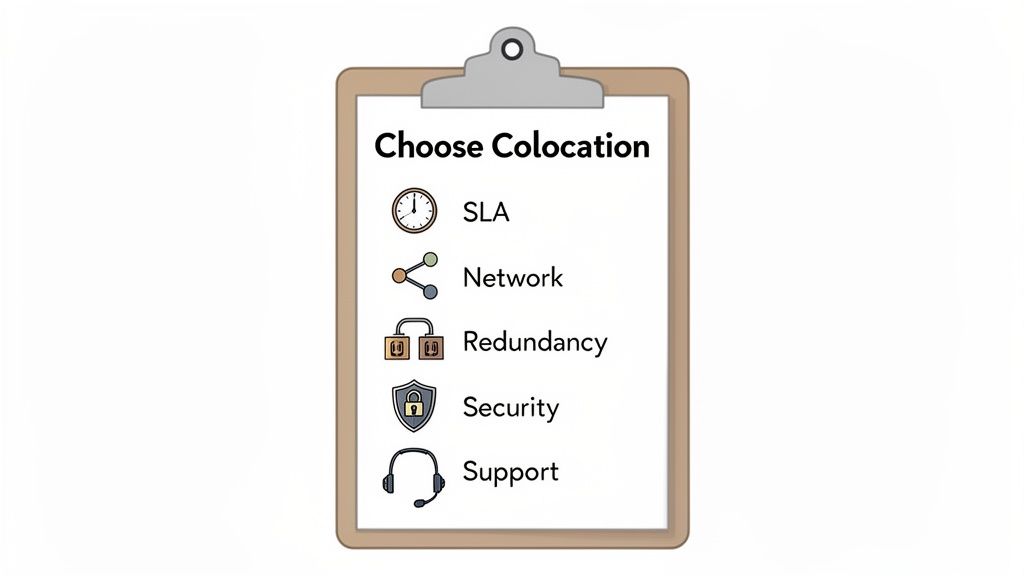
To get it right, you need a solid framework for vetting potential partners. Think of this as your buyer's checklist—a guide to asking the tough questions and zeroing in on what truly matters for your business.
Verify the Service Level Agreement
The Service Level Agreement (SLA) isn't just marketing fluff; it's the legally binding contract that spells out exactly what the provider promises to deliver. It’s the document that holds them accountable, outlining their guarantees and what happens if they fail to meet them.
Don't just nod at a high uptime number. You have to dig into the fine print. A truly solid SLA will break down its guarantees for each critical service, leaving no room for ambiguity.
- Power Availability: Look for a 99.99% or higher guarantee specifically for power delivery to your rack.
- Environmental Controls: The agreement should promise to keep temperature and humidity within the strict ranges your hardware needs to operate reliably.
- Network Connectivity: If you’re buying bandwidth from them, the SLA needs a separate, clearly defined uptime guarantee for network access.
Evaluate the Network Ecosystem
A data center is only as good as its connection to the rest of the world. The best facilities are carrier-neutral, which means they’re more like a bustling marketplace for connectivity than a one-stop-shop. They give you access to a huge menu of telecom companies and internet service providers.
This network variety is crucial for two big reasons. First, it drives competition, which keeps your connectivity costs in check. Second, it gives you powerful redundancy options. If one carrier has an outage, you can instantly failover to another. It's how a SaaS company can use one ISP for its main traffic and a second as a hot spare, ensuring their app never goes offline.
A rich network ecosystem is the hallmark of a healthy, mature data center. It gives you the freedom to pick the best network routes and prices for your needs, so you’re never locked in with a single vendor.
Confirm Resilience and Redundancy
Uptime isn’t an accident; it’s engineered through layers of redundancy. You need to confirm the facility has bulletproof backup systems for every point of failure. Don't take the sales pitch at face value—ask for proof of their resilient design.
Here are a few key questions to start with:
- Power Feeds: Does the facility provide true A+B power? This means your gear can plug into two completely independent power circuits, so if one fails, the other takes over seamlessly.
- Network Paths: Do they have diverse physical entry points for fiber cables? This simple detail prevents a single backhoe incident from severing your connection to the internet.
- Generator Testing: How often do they test their backup generators under full load? You want a provider who regularly simulates real-world outages to make sure everything works when it counts.
Scrutinize Security and Compliance
Physical security is a deal-breaker. The provider must have strict, layered protocols to keep unauthorized people away from your hardware. This means 24/7 on-site security personnel, biometric scanners, mantraps (a two-door security vestibule), and cameras covering every angle.
Compliance certifications are just as important, especially if you handle sensitive data. Look for reports that prove the facility meets tough industry standards. Certifications like SOC 2 Type II or ISO 27001 show that a third-party auditor has rigorously inspected and approved their security controls and procedures. For businesses targeting specific markets, like those looking at colocation in Dallas, Texas, it's vital to ensure the provider meets both global and local compliance requirements.
Assess Support Quality and Remote Hands
When something goes wrong at 3 a.m., the only thing that matters is the quality of the support team. You absolutely need access to expert help 24/7/365. A good test is to check their average ticket response times during your evaluation—it’s a great indicator of how they'll perform when you're a customer.
The remote hands service is your lifeline. This service lets the data center's on-site technicians be your eyes and hands, ready to perform tasks like rebooting a stuck server, swapping a failed drive, or just checking if a cable is plugged in correctly. For any team not located next door to the facility, this service can turn a crisis that would take hours or days to fix into a ten-minute phone call.
Understand the Pricing Models
Finally, make sure you have a crystal-clear understanding of how you’ll be billed. Colocation pricing isn't always straightforward and usually breaks down into three core components: the physical space, the power you use, and the network connectivity you need.
Common models you'll encounter include:
- Per-Rack: A flat monthly fee for a full or partial locking cabinet. Simple and predictable.
- Caged Space: For larger needs, you can rent a dedicated, fenced-off area on the data center floor.
- Power-Based: You’re billed for the power your equipment actually draws, typically measured in kilowatts (kW).
Ask about every potential charge—setup fees, remote hands costs, and cross-connect fees—to make sure the pricing is transparent and won't lead to surprise bills down the road.
Why Colocation Is a Smart Business Move
Think of colocation less as renting a rack and more as a strategic partnership for your infrastructure. It fundamentally changes how you manage your IT budget. Instead of sinking huge amounts of capital into building and maintaining your own data center—think concrete, power grids, and cooling systems—you shift to a predictable monthly operational cost.
This move frees up cash and, just as importantly, your team's time. Your engineers can stop worrying about the physical environment and focus on what truly matters: your applications, your data, and your customers' experience. You get to concentrate on innovation while the experts handle the complex, messy business of keeping the lights on and the servers cool.
By plugging into a colocation facility, you instantly get access to enterprise-grade infrastructure. We're talking about serious physical security, redundant power and cooling, and the kind of uptime most businesses could only dream of building themselves. Need to scale? Forget a multi-year construction project. You can add capacity in days or weeks, letting you respond to new opportunities at the speed the market demands. That kind of agility is a massive competitive edge.
A Foundation for Modern IT
Colocation isn't just about outsourcing the basics anymore; it’s the bedrock for modern IT strategies like hybrid cloud and edge computing. It gives you a stable, high-performance "home base" for your private hardware that can be directly and securely connected to major public cloud providers. This creates a seamless, resilient infrastructure that gives you the best of both worlds.
The market trends tell the same story. The global colocation market is expected to rocket from USD 84.49 billion in 2025 to a staggering USD 274.74 billion by 2034. It's often small and medium-sized businesses leading the charge, drawn to flexible solutions that deliver the low-latency performance and security their demanding applications need. You can dig into the numbers in this growth forecast for the colocation data center market.
A colocation data center empowers your business to operate with the reliability of a global enterprise without the associated cost and complexity. It’s the smart way to scale securely.
For any business that relies on applications being online 24/7, needs ironclad DDoS protection, and wants the freedom to grow without hitting a wall, colocation is the next logical step.
Frequently Asked Questions About Colocation
When you start digging into what a colocation data center can do for your business, a few key questions always seem to pop up. Let's walk through some of the most common ones to clear things up and help you figure out if this model makes sense for you.
What’s the Difference Between Retail and Wholesale Colocation?
The best way to think about this is like renting office space.
Retail colocation is like leasing a private office or a few desks in a large, shared building. You rent a specific amount of space—typically measured in server cabinets or racks—within a common data hall. This setup is ideal for small and medium-sized businesses that need a top-tier environment for a manageable number of servers.
Wholesale colocation, on the other hand, is like leasing an entire floor or the whole building. This is for the big players—large enterprises and hyperscalers—who need a massive footprint and a huge power draw for hundreds or even thousands of servers. They usually get a private, dedicated suite with its own security, power, and cooling systems.
Can I Actually Get My Hands on My Servers in the Data Center?
Absolutely. That's a fundamental part of the deal. You own the hardware, so you get to access it. Any good provider offers 24/7/365 escorted access to your equipment.
Of course, security is airtight. You'll need to follow a strict protocol, which usually means scheduling your visit ahead of time and showing a valid ID that matches their approved access list. This hands-on access is crucial for things like setting up new gear, performing major upgrades, or dealing with complex troubleshooting that you just can't do over a remote connection.
How Does Colocation Fit into a Hybrid Cloud Strategy?
Colocation is a cornerstone of a smart hybrid cloud strategy. It gives you a secure, high-performance "home base" for your most important workloads—the systems that demand predictable performance or need to comply with strict data residency rules. From this private hub, you can then build direct, high-speed, low-latency connections to public cloud providers.
Think of a colocation facility as the perfect intersection between your private infrastructure and the public cloud. It lets you seamlessly shift data and applications between both worlds, giving you the flexibility of the cloud while keeping your core assets on dedicated hardware that you completely control.
A classic example is a company that keeps its main customer database on its own servers in a colocation facility for security reasons but spins up web servers in a public cloud to handle seasonal traffic spikes.
What Kind of On-Site Support Should I Expect?
The data center staff are essentially your on-the-ground partners. Their most valuable service is often called Remote Hands. This service is a lifesaver, allowing you to ask trained technicians to perform physical tasks for you. Need to reboot a frozen server at 3 AM? Check a loose cable? Swap out a faulty hard drive? They've got it covered.
Beyond that, you can count on them for 24/7 security monitoring, managing the facility's power and cooling systems, and providing support for any issues with the infrastructure they provide. Having that expert team on-site means your hardware is always in good hands, even when you're miles away.
Ready to build your infrastructure on a foundation of performance, security, and scalability? Soraxus provides enterprise-grade colocation with A+B power, 24/7 physical security, and expert remote hands support to keep your mission-critical applications online and protected. Explore our colocation solutions.